Novice to Advanced Marketing System

NAMS | Building an Online Business to Support Your Dreams

  • Home
  • Product Catalog
  • Free Resources
  • Affiliates
  • Support
  • Blog
  • Masterminds
    • NAMS 90 Mastermind
    • Affiliate Sales Dominators Mastermind
    • Idea To Income Mastermind

Make Money Blogging Fast or Build Your List? Why not both! Member Content

By Jen Perdew Leave a Comment

make money blogging fast

Which do you want to do? Make Money Blogging Fast or Build Your List? Why not both!

People get confused about their blog because they don’t know whether they’re supposed to make money blogging fast, or build your list.

I get that question all the time. We suggest doing both.

Everyone is talking about how blogging for profit as a fast and easy way for you to earn a living.

Well, I’m not so sure about fast or easy…

But there is a way for you to increase your list size and make your blog profitable.

First, let me tell you my theory on blogging. This is how I’ve made money blogging.

My blog is not my primary source of income.

I’m interested in list building because there is a ton of value in creating a list but also making sales. 

But normally if you’re interested in niche blogging for profit, you’re going to have to promote a ton of affiliate products.

Nothing wrong with it except that you give up control when you’re sending all of your traffic somewhere else.

So here’s how we do it.

We write “Epic” or “Cornerstone” content.

These are blog posts that are fairly evergreen. They can be used over and over again because they educate the reader on a topic that isn’t going out of style. Or isn’t a fad.

Already, you can see that blogging is a very strategic activity. We don't just throw up a bunch of content and hope you'll read it. There's a process.

Being clear on the goal is key. And our goal is to focus on list building AND making money from blogging at the same time.

When we write an epic or cornerstone piece of blog content, we’re implementing an income stream strategy. Let’s go through the process next.

I actually write two posts!

YUP. You heard me.

Blog post #1 is my list building post.

It’s the post that lives in the blog section of my website and I use to promote on social media.

The call to action for this post is an opportunity for the reader to sign up for something free. Normally a lead magnet, a download, checklist…something valuable and something that relates to the topic I’m writing about.

earn money blogging

Blog post #2 is my sales post and I don’t put it in the main blog on my website. I use a category called exclusive member content.

It’s just a way for me to stay a little more organized.

This is a duplicate of post #1 but instead of giving the reader an opt-in opportunity, I give them a sales opportunity.

Even though it may seem like I’m doubling my efforts, I’m not at all. Writing the blog post is the hardest part of this project. It takes very little time to change out the call to action.

And I’m creating content for two completely different segments of my market.

I love using blog content to engage with the readers on my list.

But they’re already on my list and they have access to all my lead magnets and free content anyway. Why would I want to show them content that asks them to sign up for my list again?

I don’t.

So when I’m sending out a blog post to my existing list, I give them an opportunity to buy the product I’m writing about.

This strategy works well.

Let me give you a quick breakdown of the tools I use to do this and I’ll show you an example of a piece of content and reveal the results over the past 90 days.

Steps To Start A Blog For Profit

Step 1 - Get Started Writing Your Blog Post:

Before I write one word of my blog post, I’ve chosen my call to action. That way my content is SUPER CONGRUENT with my CTA. So I’ve picked my lead magnet and I’ve picked the product I’ll be promoting.

I use Google Docs to get started. I think about the topic, do a little research to find experts and statistics that back up my premise, and then, I just start writing.

 Once I’ve done my first draft, I re-organize a little bit to make sure I’m really hitting the points I want to hit.

Step 2 - I optimize it for the best search engine results:

Using my best keywords allows me to write content that will easily be found on the web. While I do want to share my content on social media, I also want my content to be found organically. To do this we use Long Tail Pro (this is an incredible keyword search tool).

After finding the keywords, make my edits to the content to make sure the keywords fit in nicely, make sense without falling into the keyword stuffing trap.

Step 3 - Search for appropriate images:

Sometimes I spend more time looking for the perfect image than I do writing the post. I use DepositPhotos, Stock Unlimited and Canva to create my images.

Step 4 - Embed my call to action on the post:

I use a tool I love called Optin Monster. This is a pop-up creator. I’ve been using it for 3 years and it pays for itself 100 times over each year.

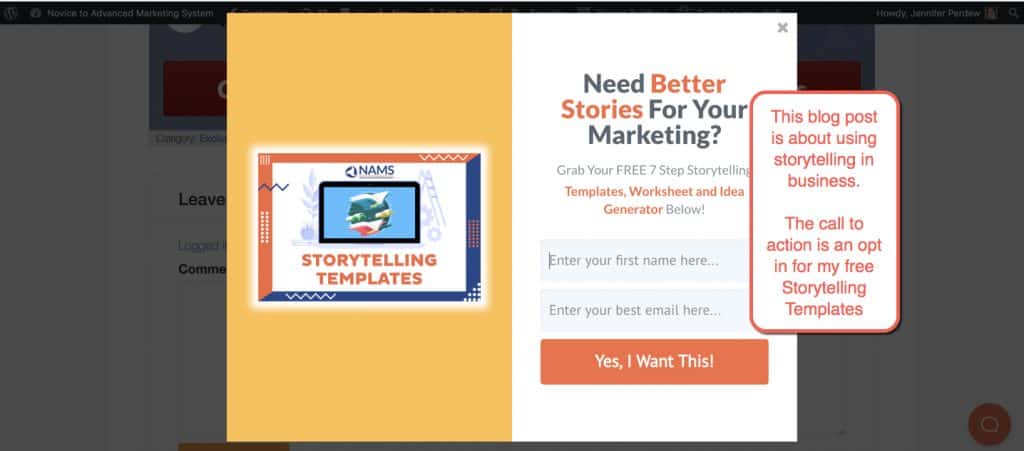
I like to use Optin Monster because I can really track my conversions. I can create single campaigns and use them in multiple places. For example, one single pop up can be used as an exit pop, a timed pop-up or an embedded opt-in. I know that sounds a little complicated so here’s a visual of what it looks like.

This is a campaign that’s generated a TON of leads and sales.

Example: Post #1 call to action is for list building

I distributed this on social media and ran Facebook ads to it.

I’ve had over 800 opt in’s from this blog post since I published it 90 days ago.

This is an image of the pop-up. 

I’ve used this pop-up in two places. 

As an exit pop and when someone reads 80% of my content. If the reader has made it 80% down my page then they are uber engaged. 
how do bloggers make money

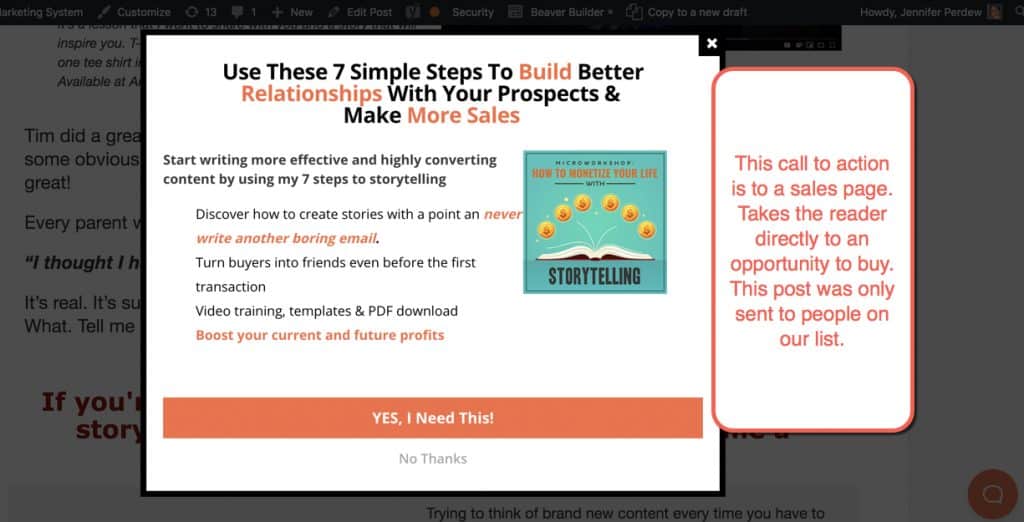
Example: Post #2 call to action is for sales

This is the same exact content as post # 1 except the call to action is different.

This post has generated over $2000 in sales by dripping it out to our existing list over the past 60 days.

I’ve used this pop up in two places as well. 

First, it shows up when the reader has made it 80% of the way through my content. Same reasoning as above. 80% means engaged. 

It’s also used as an embedded call to action at the bottom of the post as well.
make money blogging

So if you’re looking to make money blogging fast, there are some key elements you need to implement.

With my easy-to-follow course, we focus on real paths to success, not short-lived, game-the-system tricks.

There are no push button riches, no loopholes. Just the building blocks most people skip - and then they wonder why they failed.

In my course, Blogging Like a Pro, I’ll walk you through a step-by-step process for defining what your ideal reader wants from you.

Blogging Like a PRO: From Post to Profit

The Step-by-Step Blogging Masterclass
Blogging To Make Sales
  • Get your readers to tell you what they want you to write about.
  • Consistently write new material and focus on quality, not quantity.
  • Understand current blogging tactics with the right article length, images and metrics.
  • Discover how to easily make money from your blog by giving readers what they want.
Yes, I Want A More Profitable Blog!

Category: Exclusive Content For Members

Storytelling – How to Write a Story to Grow Your Business – SSA V2

By Jen Perdew Leave a Comment

Are you using the Power of Storytelling to build your story brand and dominate your competitors?

Storytelling: A Fundamental Guide to Becoming THE Storyteller by Learning How to Write a Story that Persuades...

There’s no better way to build relationships than with stories and becoming the storyteller.

If you have a blog, Facebook page or another publishing platform for communicating with your tribe, then, your job is to fill that platform with stories that persuade your prospects to take an action you want them to take.

So, you must learn how to write a story that sells, and the art of writing stories.

Stories aren’t just long tales. Good storytelling reveals evidence. Stories provide proof of your thesis.

People tell me all the time, “David, you're a born storyteller.”

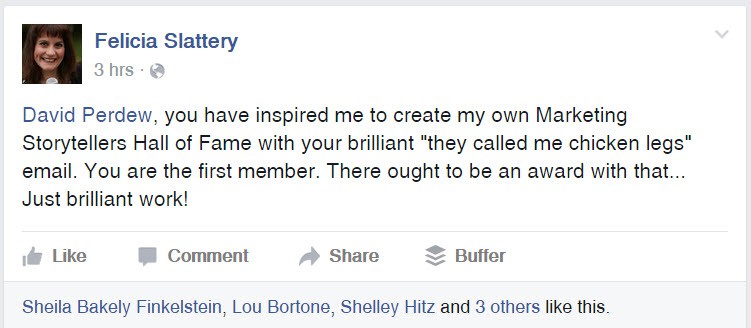
And I do have a bit of a reputation for my storytelling ability in email and blog posts. Below, you’ll see one that came in from Felicia Slattery, one of the top speaking coaches in the US.

But the truth is, I've never met a born storyteller.

And I certainly am not one.

All the great persuasive storytellers that I know have learned that skill through practice and patience.

It IS a skill. And if you don't learn the skill, then chances are that you’ll fall flat.

Instead of informing and entertaining, you become self-indulgent and annoying.

Don’t do that.

business storytelling techniques

Learn the storytelling process

Why? Stories sell. If you're in business (and I assume that everyone reading this is in business), it's really important for you to focus on why you do what you do.

It’s the same with storytelling.

The London School of Business did a study on selling with stories and it confirmed what we all suspected.

People retain 65 to 70 percent of information shared through stories while only 5 to10 percent of information is retained through dry presentation of data and statistics.

Storytelling is the most effective way to persuade people to take an action because they are invested in the story AND they want to listen to your tale instead of being resistant to a sales message.

Great storytelling is the best way to build real relationships. And as The Storyteller, you have the power and authority of the microphone - or the computer keyboard, and can build a relationship with dozens or even thousands of people at a time.

One of my favorite sayings is that every action should have a marketing result. That means every activity becomes a profit center.

Every story, every communication, every persuasive email – all are little sales people running into the world to represent you and your brand. If you’re not building relationships with those tools, you’re driving folks away.

That is exactly why we focus on storytelling and how to get marketing results from stories.

Storytelling is even more important today because of the shifting communication platforms

There are two basic schools of marketing online. The first is old school. The second is new.

business storytelling training

Old School Marketing

To understand Old School vs New School, you have to first understand Advertising and Publishing. They’ve been intertwined for centuries.

The publisher controlled the advertising because he had the press or broadcast spectrum.

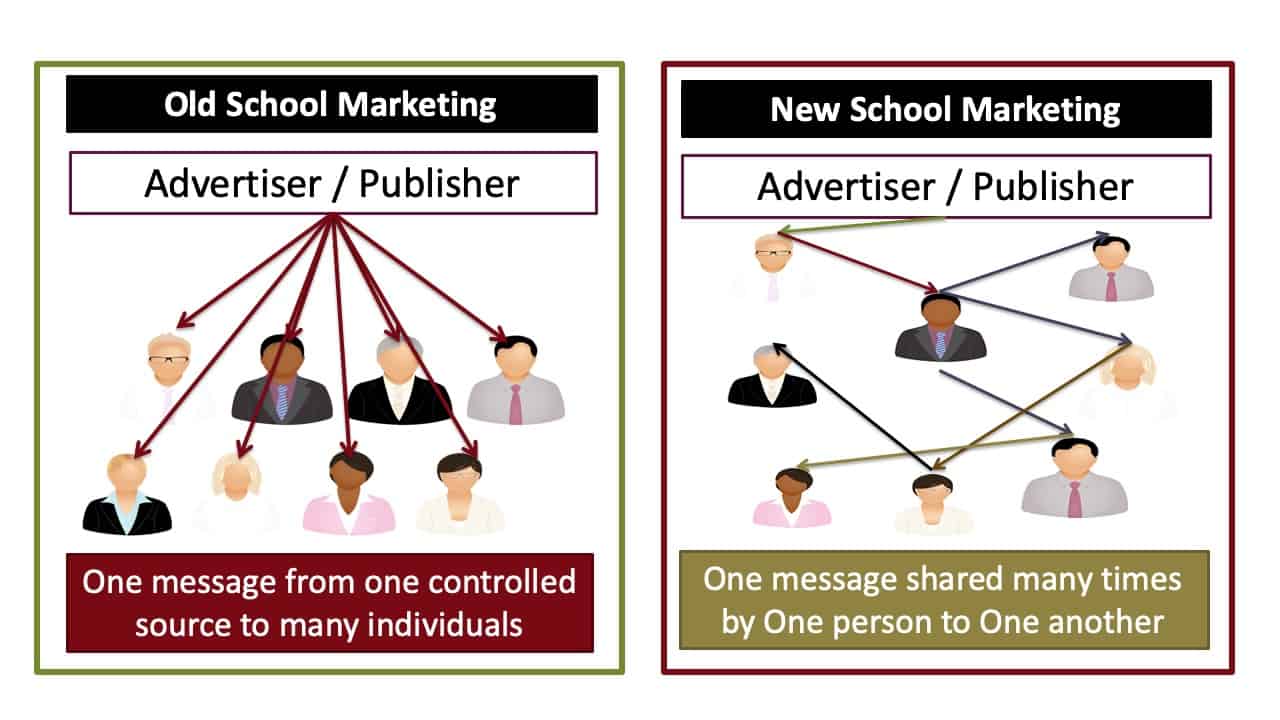
In the old days, an advertiser or a publisher sent out a single message from a single source trying to reach as many people as possible and convert them by controlling who saw that single message. It was a numbers game, a shotgun blast.

The one-to-many broadcast method is still effective, but not as effective or FAST as more modern methods.

The Old School approach was called interruption marketing. And it is basically the province of commercial publications such as magazines and newspapers, television and all of that.

Here's a quick example of how interruption marketing is changing:

How do you watch TV today?

Do you sit down at the appointed time when your favorite program is broadcast?

That's the way it was when I was growing up. If you wanted to watch your favorite program, you sat down in front of the TV at the appointed time and watched - including the commercials or you might miss part of the program.

Today, according to a 2017 Accenture global study, only 23 percent of people around the world watch their favorite programs on a television set. (The rest are watching on mobile, computer or gaming devices.)

And of those 23 percent, many of them will watch recorded programs while fast-forwarding through the commercials.

Old School advertising has shifted. But to what…

New School Marketing…

Today, the audience is in control of the distribution of the content. And the better the story, the better the distribution because it’s all about sharing.

With the advent of social media, the number of shares and views is the key to everything. Unknown stars are born on Youtube and Instagram because people relate and it spreads like wildfire.

Relationships are built with the new “influencer”... which is kind of weird when you think about it, because the relationship only exists as long as they follow the influencer and check in regularly for new content.

Why?

Because they’ve created a story about themselves that their followers love and that they will distribute for them… They feel connected to a star...

Today, advertisers and publishers send out a message to the masses - hopefully through an influencer - and then rely on individuals to share that information.

If the story is not share worthy, it dies.

Creating viral content is all about sharing good stories.

Big brands have finally caught on and realized that storytelling is the future of advertising

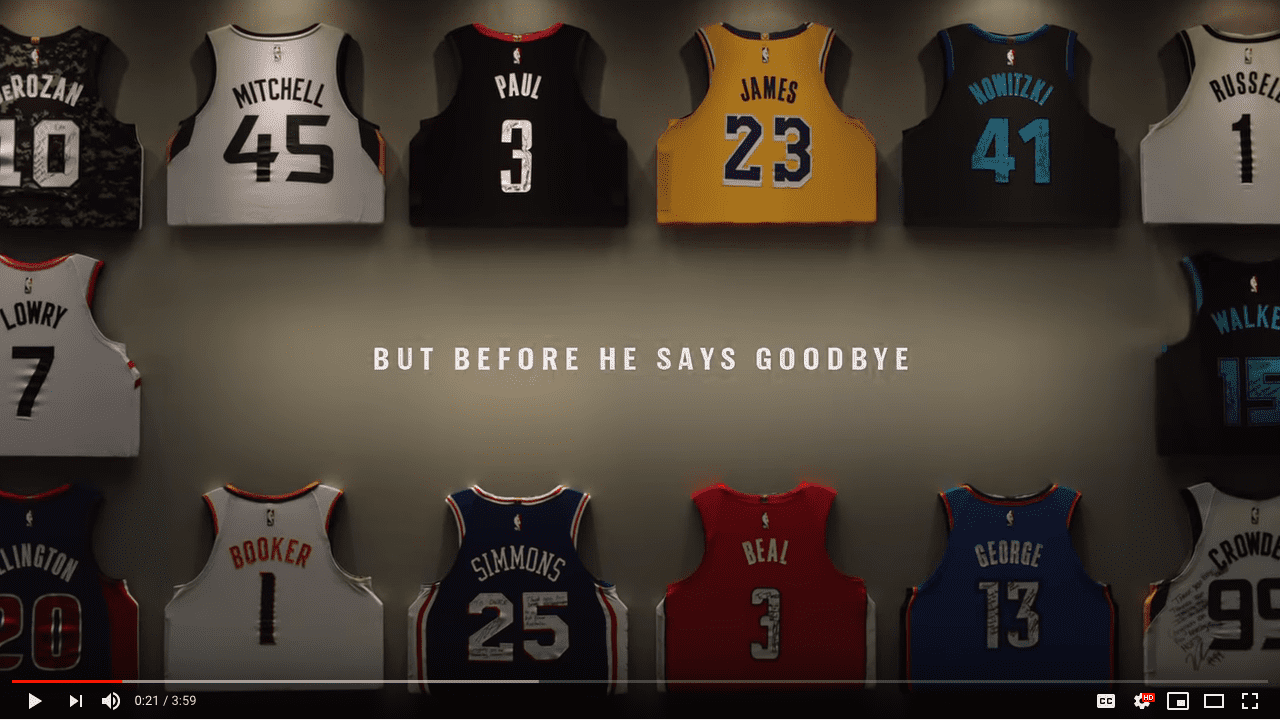
When NBA All Star Dwayne Wade announced that the 2018-2019 season would be his last as an active pro basketball player, Budweiser (master storytellers for years) saw an opportunity to honor him.

Wade had been swapping jerseys with other NBA players after key games. Budweiser took that interesting fact about Wade and produced a poignant story about him.

In less than a month, the YouTube video had 5 million shares.

It’s impossible to watch the 4-minute video without being moved by his humanity.

And if you watch it closely and you’ll see the 7-step storytelling process… because all great stories follow that process.

The storytelling process is the reason Facebook and YouTube are so amazing - for good or bad.

We’re entertained by the stories and allow ourselves to get sucked in to Facebook and YouTube and Instagram because we love to share those stories with other people.

Click on the video to watch the story...


If storytelling is so effective, why isn’t everyone doing it?

There’s a serious problem with storytelling - and it’s mostly between your ears.

Right now, you're probably thinking…

  • I don't have any stories!
  • My stories aren't interesting…
  • Nothing interesting ever happens to me…

Of course, that’s not true.

Once you learn how to tell stories from your everyday life that persuade people to take the action you want them to take, you’ll realize that EVERYTHING is fodder for a good story.

And they don’t even have to be your experience. You can tell a story about something that happened to someone else if you talk about how it relates to you.

But maybe you’re thinking …

“I’m afraid of revealing too much about myself. I’m a very private person.”

It’s true. You can tell too much.

But you have to try really, really hard to reveal too much.

Below are a few examples of different ways to expose your heart while telling stories that move people to action. And sometimes that action is simply to like, share or comment. But that small action is enough to help you build better relationships which will in turn help your business.

Good storytellers use tragedy recounting terrible episodes in their lives that reveal the lessons they’ve learned. And by doing that, they establish immediate rapport and empathy with the audience. It’s the beginning of a relationship.

business storytelling exercises

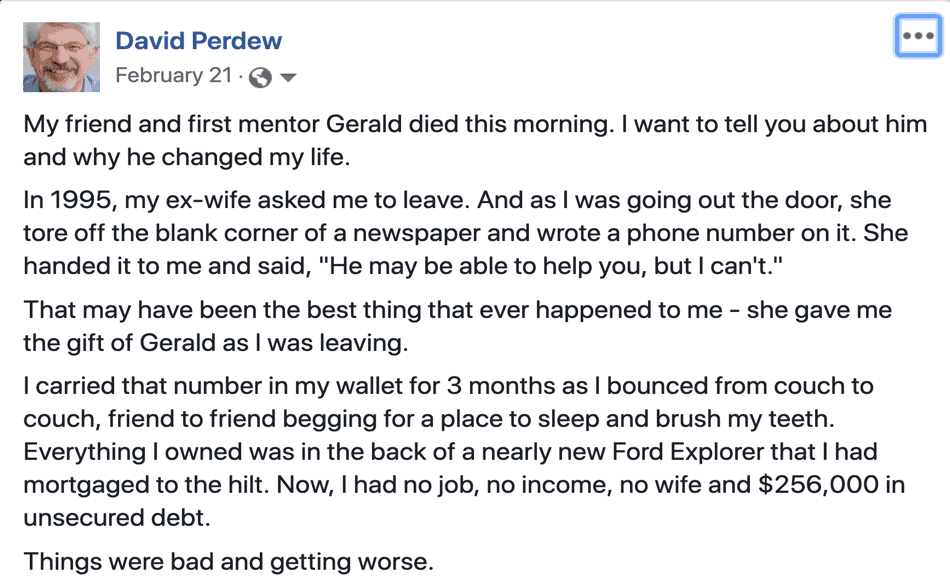
This was a long post. And while I wrote it as a tribute to my great friend and mentor Gerald, I also wanted people to understand the power of mentorship. To do that, I had to reveal the lowest point in my life and how Gerald helped me out of it.

My goal was not to sell anything. It would have been really crass to add at the bottom of the story, “And if you’d like to improve your life, hire me as a mentor too… and you’ll get what I got from Gerald.”

I would never do that.

But I definitely wanted to praise him and demonstrate how he helped me climb out of my hole. To do that, I had to expose my heart. People responded with likes, shares and comments. None were negative.

Is it manipulative? No, because I was writing from my heart and letting you into my world. If you never read another story I write, that’s okay too.

GeraldPostShares

Risking ridicule or embarrassment, storytellers often reveal something really stupid, silly or emotional that’s happened in their lives. And of course, those episodes come with lessons that can be shared, or you can present a solution that helps your reader avoid that same mistake.

Below, is the first 100 words of a 900 word email. Now, you might be thinking, “900 Words! Who’s going to read a 900 word email?”

Many, many people did, and I got a ton of engagement. It was a story that led to an opportunity to meet personally and talk about a nutrition program.

“Subject: They called me chicken legs…

Hey there ~Contact.FirstName~

I’m really hesitant to tell you this because it’s a little embarrassing, but here goes...

When I was in junior high school in New Castle, Indiana, I got tagged with a nickname that haunted me for many years:

Chicken Legs!

Even now, when I look at my skinny legs, I think about those folks who called me chicken legs. In a minute, I’ll tell you how I got stuck with that name, but first let’s go back to a time long, long ago…

I was very skinny…”

I could talk about one of the most embarrassing and hurtful times of my youth, and what I learned from it, because I’m willing to be open and vulnerable with my community.

After years of reading these types of stories, the community expects it - no, demands it from me. I can’t get away with sending short, straight-to-the-point emails. My friend and mentor, Matt Bacak, makes millions with email. A 100-word email from Matt would be an epic post. His audience expects short and direct.

Mine does not respond to those.

If you're going to be successful online, especially if storytelling is going to be part of your portfolio, you become a bit more transparent.

To relate to people, you have to be relatable.

Be real.

So, I encourage you to let go of the facade that you try to hide behind. We all have that facade to protect us. But, in the end, it’s what holds us back.

Once you understand the process, storytelling is simple.

Search your day with an open mind, and you’ll find story possibility after story possibility.

I guarantee you that interesting things are happening all around you.

You’re learning lessons every day and you can build stories from that experience. If not your story, you can tell stories about other people - living and dead - and relate to those to make them your own so they reveal the truth that you discovered in your daily living.

To get started telling stories from your life that persuade others, use our proven structure that works. That’s why I developed a 7-step template to tell persuasive stories with a point.

This 7-step process has worked since cavemen were telling stories around the campfire about the day’s events.

The 7-steps are:

  • The Hook
  • The Setup
  • The Parachute
  • The Theme
  • The Transition
  • The Sell
  • The Tie Back - or Resolution

I describe each of those in the template itself, so be sure to grab it.

Wait, that’s not what I learned in high school English class…

Mr. Dicken was my English teacher. I loved him, and he taught me about great writing. We covered all four types of writing:

  • Expository – Writing in which author’s purpose is to inform or explain the subject to the reader.
  • Persuasive – Writing that states the opinion of the writer and attempts to influence the reader.
  • Narrative – Writing in which the author tells a story. The story could be fact or fiction.
  • Descriptive – A type of expository writing that uses the five senses to paint a picture for the reader. This writing incorporates imagery and specific details.

Persuasive Storytelling is not what you learned in college or in high school.

In journalism school, we’re taught to start with the LEDE - that’s always the most important information, not necessarily the most engaging.

And that’s important if you’re scanning the news site (or newspaper if you’re as old as me) because you can read the first couple of paragraphs of all the stories and get really well informed.

None of the four writing types really fit what we’re doing as storytellers… or do they?

Actually, ALL four types of writing are using in storytelling.

In a really good story, the teller is:

Shaping a situation (using descriptive writing) by telling a relevant story (using narrative writing) that helps the reader understand (using expository writing), the reader takes the action that you lay out (using persuasive writing).

Mr. Dicken would be proud of me.

I can’t really get into the entire 7-step process today in this blog post because it’s already gone on too long, but let’s look at the first step - The Hook...

The Hook is the KEY element in persuasive storytelling.

It has to be intriguing, shocking, surprising, astounding, paradoxical… You get the point. It’s a grabber.

Isn’t that usually the headline? Very often, it can be.

Let's look at a great hook.

One of our students, Tim Maudlin, came to us with a problem.

When I first met Tim, we had a short consultation call. He said, “You know, I don't think I actually have a business that can be converted to online.”

He did t-shirts for causes -  charitable, personal or medical challenges, or church causes.

After talking a bit and taking our storytelling course, he produced a 66-second video. Remember, the hook is the first thing to grab your attention. Here’s the transcript of the video below:

“I thought I had just killed my boys.

Friday, March 2nd, 2012 is a day I'll never forget. That’s the day a tornado ripped apart my hometown. My boys didn't die that day. But five of our neighbors did.

The next day, March 3rd, 2012 is also a day I'll never forget because on that day I learned one very simple yet important lesson from one t-shirt that made a difference in my life and in my community.

It’s a lesson that I want to share with you and a story that will inspire you. T-shirts that inspire. The $89,000 tee shirt. How one tee shirt inspired and healed a broken community. Available at Amazon.com.”


Tim did a great job with is following our 7-step template and produced an intriguing story. There are some obvious places to improve that script and we go over it in the course, but his Hook was great!

Every parent wants to know what happened after he says...

“I thought I had just killed my boys.”

It’s real. It’s surprising. It’s gut-wrenching. And we want to close the loop it just opened. How. Why. What. Tell me more.

If you're ready to grow your business with content, we're here to help you become a master storyteller.

Microworkshop-How-to-Monetize-Your-Life-with-Storytelling

Trying to think of brand new content every time you have to write a blog post, an email or a sales page can be incredibly overwhelming. 

When you start taking situations and events from your life and relating them to your business, it becomes easier to write. Plus your readers and prospects become more invested in your because of your openness and honesty.

Once you've mastered the strategy, you'll find yourself writing your next email or blog post while you're mowing the yard, taking a shower or washing the dishes because you've already mastered the structure and framework. Then when you sit down at the computer, the story and the content flows.

So if you're ready to master the skill of storytelling, you'll love this workshop. Click now and be sure to use the coupon on the bottom of the page

YES, I'm Ready To Write Stories To Grow My Business

Category: Exclusive Content For Members

Storytelling – How to Write a Story to Grow Your Business – SSA

By Jen Perdew Leave a Comment

Are you using the Power of Storytelling to build your story brand and dominate your competitors?

Storytelling: A Fundamental Guide to Becoming THE Storyteller by Learning How to Write a Story that Persuades...

There’s no better way to build relationships than with stories and becoming the storyteller.

If you have a blog, Facebook page or another publishing platform for communicating with your tribe, then, your job is to fill that platform with stories that persuade your prospects to take an action you want them to take.

So, you must learn how to write a story that sells, and the art of writing stories.

Stories aren’t just long tales. Good storytelling reveals evidence. Stories provide proof of your thesis.

People tell me all the time, “David, you're a born storyteller.”

And I do have a bit of a reputation for my storytelling ability in email and blog posts. Below, you’ll see one that came in from Felicia Slattery, one of the top speaking coaches in the US.

But the truth is, I've never met a born storyteller.

And I certainly am not one.

All the great persuasive storytellers that I know have learned that skill through practice and patience.

It IS a skill. And if you don't learn the skill, then chances are that you’ll fall flat.

Instead of informing and entertaining, you become self-indulgent and annoying.

Don’t do that.

business storytelling techniques

Learn the storytelling process

Why? Stories sell. If you're in business (and I assume that everyone reading this is in business), it's really important for you to focus on why you do what you do.

It’s the same with storytelling.

The London School of Business did a study on selling with stories and it confirmed what we all suspected.

People retain 65 to 70 percent of information shared through stories while only 5 to10 percent of information is retained through dry presentation of data and statistics.

Storytelling is the most effective way to persuade people to take an action because they are invested in the story AND they want to listen to your tale instead of being resistant to a sales message.

Great storytelling is the best way to build real relationships. And as The Storyteller, you have the power and authority of the microphone - or the computer keyboard, and can build a relationship with dozens or even thousands of people at a time.

One of my favorite sayings is that every action should have a marketing result. That means every activity becomes a profit center.

Every story, every communication, every persuasive email – all are little sales people running into the world to represent you and your brand. If you’re not building relationships with those tools, you’re driving folks away.

That is exactly why we focus on storytelling and how to get marketing results from stories.

Storytelling is even more important today because of the shifting communication platforms

There are two basic schools of marketing online. The first is old school. The second is new.

business storytelling training

Old School Marketing

To understand Old School vs New School, you have to first understand Advertising and Publishing. They’ve been intertwined for centuries.

The publisher controlled the advertising because he had the press or broadcast spectrum.

In the old days, an advertiser or a publisher sent out a single message from a single source trying to reach as many people as possible and convert them by controlling who saw that single message. It was a numbers game, a shotgun blast.

The one-to-many broadcast method is still effective, but not as effective or FAST as more modern methods.

The Old School approach was called interruption marketing. And it is basically the province of commercial publications such as magazines and newspapers, television and all of that.

Here's a quick example of how interruption marketing is changing:

How do you watch TV today?

Do you sit down at the appointed time when your favorite program is broadcast?

That's the way it was when I was growing up. If you wanted to watch your favorite program, you sat down in front of the TV at the appointed time and watched - including the commercials or you might miss part of the program.

Today, according to a 2017 Accenture global study, only 23 percent of people around the world watch their favorite programs on a television set. (The rest are watching on mobile, computer or gaming devices.)

And of those 23 percent, many of them will watch recorded programs while fast-forwarding through the commercials.

Old School advertising has shifted. But to what…

New School Marketing…

Today, the audience is in control of the distribution of the content. And the better the story, the better the distribution because it’s all about sharing.

With the advent of social media, the number of shares and views is the key to everything. Unknown stars are born on Youtube and Instagram because people relate and it spreads like wildfire.

Relationships are built with the new “influencer”... which is kind of weird when you think about it, because the relationship only exists as long as they follow the influencer and check in regularly for new content.

Why?

Because they’ve created a story about themselves that their followers love and that they will distribute for them… They feel connected to a star...

Today, advertisers and publishers send out a message to the masses - hopefully through an influencer - and then rely on individuals to share that information.

If the story is not share worthy, it dies.

Creating viral content is all about sharing good stories.

Big brands have finally caught on and realized that storytelling is the future of advertising

When NBA All Star Dwayne Wade announced that the 2018-2019 season would be his last as an active pro basketball player, Budweiser (master storytellers for years) saw an opportunity to honor him.

Wade had been swapping jerseys with other NBA players after key games. Budweiser took that interesting fact about Wade and produced a poignant story about him.

In less than a month, the YouTube video had 5 million shares.

It’s impossible to watch the 4-minute video without being moved by his humanity.

And if you watch it closely and you’ll see the 7-step storytelling process… because all great stories follow that process.

The storytelling process is the reason Facebook and YouTube are so amazing - for good or bad.

We’re entertained by the stories and allow ourselves to get sucked in to Facebook and YouTube and Instagram because we love to share those stories with other people.

Click on the video to watch the story...


If storytelling is so effective, why isn’t everyone doing it?

There’s a serious problem with storytelling - and it’s mostly between your ears.

Right now, you're probably thinking…

  • I don't have any stories!
  • My stories aren't interesting…
  • Nothing interesting ever happens to me…

Of course, that’s not true.

Once you learn how to tell stories from your everyday life that persuade people to take the action you want them to take, you’ll realize that EVERYTHING is fodder for a good story.

And they don’t even have to be your experience. You can tell a story about something that happened to someone else if you talk about how it relates to you.

But maybe you’re thinking …

“I’m afraid of revealing too much about myself. I’m a very private person.”

It’s true. You can tell too much.

But you have to try really, really hard to reveal too much.

Below are a few examples of different ways to expose your heart while telling stories that move people to action. And sometimes that action is simply to like, share or comment. But that small action is enough to help you build better relationships which will in turn help your business.

Good storytellers use tragedy recounting terrible episodes in their lives that reveal the lessons they’ve learned. And by doing that, they establish immediate rapport and empathy with the audience. It’s the beginning of a relationship.

business storytelling exercises

This was a long post. And while I wrote it as a tribute to my great friend and mentor Gerald, I also wanted people to understand the power of mentorship. To do that, I had to reveal the lowest point in my life and how Gerald helped me out of it.

My goal was not to sell anything. It would have been really crass to add at the bottom of the story, “And if you’d like to improve your life, hire me as a mentor too… and you’ll get what I got from Gerald.”

I would never do that.

But I definitely wanted to praise him and demonstrate how he helped me climb out of my hole. To do that, I had to expose my heart. People responded with likes, shares and comments. None were negative.

Is it manipulative? No, because I was writing from my heart and letting you into my world. If you never read another story I write, that’s okay too.

GeraldPostShares

Risking ridicule or embarrassment, storytellers often reveal something really stupid, silly or emotional that’s happened in their lives. And of course, those episodes come with lessons that can be shared, or you can present a solution that helps your reader avoid that same mistake.

Below, is the first 100 words of a 900 word email. Now, you might be thinking, “900 Words! Who’s going to read a 900 word email?”

Many, many people did, and I got a ton of engagement. It was a story that led to an opportunity to meet personally and talk about a nutrition program.

“Subject: They called me chicken legs…

Hey there ~Contact.FirstName~

I’m really hesitant to tell you this because it’s a little embarrassing, but here goes...

When I was in junior high school in New Castle, Indiana, I got tagged with a nickname that haunted me for many years:

Chicken Legs!

Even now, when I look at my skinny legs, I think about those folks who called me chicken legs. In a minute, I’ll tell you how I got stuck with that name, but first let’s go back to a time long, long ago…

I was very skinny…”

I could talk about one of the most embarrassing and hurtful times of my youth, and what I learned from it, because I’m willing to be open and vulnerable with my community.

After years of reading these types of stories, the community expects it - no, demands it from me. I can’t get away with sending short, straight-to-the-point emails. My friend and mentor, Matt Bacak, makes millions with email. A 100-word email from Matt would be an epic post. His audience expects short and direct.

Mine does not respond to those.

If you're going to be successful online, especially if storytelling is going to be part of your portfolio, you become a bit more transparent.

To relate to people, you have to be relatable.

Be real.

So, I encourage you to let go of the facade that you try to hide behind. We all have that facade to protect us. But, in the end, it’s what holds us back.

Once you understand the process, storytelling is simple.

Search your day with an open mind, and you’ll find story possibility after story possibility.

I guarantee you that interesting things are happening all around you.

You’re learning lessons every day and you can build stories from that experience. If not your story, you can tell stories about other people - living and dead - and relate to those to make them your own so they reveal the truth that you discovered in your daily living.

To get started telling stories from your life that persuade others, use our proven structure that works. That’s why I developed a 7-step template to tell persuasive stories with a point.

This 7-step process has worked since cavemen were telling stories around the campfire about the day’s events.

The 7-steps are:

  • The Hook
  • The Setup
  • The Parachute
  • The Theme
  • The Transition
  • The Sell
  • The Tie Back - or Resolution

I describe each of those in the template itself, so be sure to grab it.

Wait, that’s not what I learned in high school English class…

Mr. Dicken was my English teacher. I loved him, and he taught me about great writing. We covered all four types of writing:

  • Expository – Writing in which author’s purpose is to inform or explain the subject to the reader.
  • Persuasive – Writing that states the opinion of the writer and attempts to influence the reader.
  • Narrative – Writing in which the author tells a story. The story could be fact or fiction.
  • Descriptive – A type of expository writing that uses the five senses to paint a picture for the reader. This writing incorporates imagery and specific details.

Persuasive Storytelling is not what you learned in college or in high school.

In journalism school, we’re taught to start with the LEDE - that’s always the most important information, not necessarily the most engaging.

And that’s important if you’re scanning the news site (or newspaper if you’re as old as me) because you can read the first couple of paragraphs of all the stories and get really well informed.

None of the four writing types really fit what we’re doing as storytellers… or do they?

Actually, ALL four types of writing are using in storytelling.

In a really good story, the teller is:

Shaping a situation (using descriptive writing) by telling a relevant story (using narrative writing) that helps the reader understand (using expository writing), the reader takes the action that you lay out (using persuasive writing).

Mr. Dicken would be proud of me.

I can’t really get into the entire 7-step process today in this blog post because it’s already gone on too long, but let’s look at the first step - The Hook...

The Hook is the KEY element in persuasive storytelling.

It has to be intriguing, shocking, surprising, astounding, paradoxical… You get the point. It’s a grabber.

Isn’t that usually the headline? Very often, it can be.

Let's look at a great hook.

One of our students, Tim Maudlin, came to us with a problem.

When I first met Tim, we had a short consultation call. He said, “You know, I don't think I actually have a business that can be converted to online.”

He did t-shirts for causes -  charitable, personal or medical challenges, or church causes.

After talking a bit and taking our storytelling course, he produced a 66-second video. Remember, the hook is the first thing to grab your attention. Here’s the transcript of the video below:

“I thought I had just killed my boys.

Friday, March 2nd, 2012 is a day I'll never forget. That’s the day a tornado ripped apart my hometown. My boys didn't die that day. But five of our neighbors did.

The next day, March 3rd, 2012 is also a day I'll never forget because on that day I learned one very simple yet important lesson from one t-shirt that made a difference in my life and in my community.

It’s a lesson that I want to share with you and a story that will inspire you. T-shirts that inspire. The $89,000 tee shirt. How one tee shirt inspired and healed a broken community. Available at Amazon.com.”


Tim did a great job with is following our 7-step template and produced an intriguing story. There are some obvious places to improve that script and we go over it in the course, but his Hook was great!

Every parent wants to know what happened after he says...

“I thought I had just killed my boys.”

It’s real. It’s surprising. It’s gut-wrenching. And we want to close the loop it just opened. How. Why. What. Tell me more.

If you're ready to grow your business with content, we're here to help you become a master storyteller.

Today, get the start you need to become a persuasive storyteller with our templates and worksheets - IT'S FREE!

7 Steps to Telling a Story with a Point Infographic - This graphic walks through all 7 steps of creating a quality story.

Storytelling Template Worksheet - A document for you to create each piece of your story using each of the 7 steps.

Excel Idea Worksheet - Generate your ideas and test the universal truth behind those ideas

Sample ideas using the Excel Idea Worksheet to lead you along the right path to design your stories

Click Here And Grab Your Free Storytelling Templates
 

Category: Exclusive Content For Members

Storytelling – How to Write a Story to Grow Your Business – FB

By Jen Perdew Leave a Comment

storytelling email marketing

Are you using the Power of Storytelling to build your story brand and dominate your competitors?

Storytelling: A Fundamental Guide to Becoming THE Storyteller by Learning How to Write a Story that Persuades...

There’s no better way to build relationships than with stories and becoming the storyteller.

If you have a blog, Facebook page or another publishing platform for communicating with your tribe, then, your job is to fill that platform with stories that persuade your prospects to take an action you want them to take.

So, you must learn how to write a story that sells, and the art of writing stories.

Stories aren’t just long tales. Good storytelling reveals evidence. Stories provide proof of your thesis.

People tell me all the time, “David, you're a born storyteller.”

And I do have a bit of a reputation for my storytelling ability in email and blog posts. Below, you’ll see one that came in from Felicia Slattery, one of the top speaking coaches in the US.

But the truth is, I've never met a born storyteller.

And I certainly am not one.

All the great persuasive storytellers that I know have learned that skill through practice and patience.

It IS a skill. And if you don't learn the skill, then chances are that you’ll fall flat.

Instead of informing and entertaining, you become self-indulgent and annoying.

Don’t do that.

business storytelling techniques

Learn the storytelling process

Why? Stories sell. If you're in business (and I assume that everyone reading this is in business), it's really important for you to focus on why you do what you do.

It’s the same with storytelling.

The London School of Business did a study on selling with stories and it confirmed what we all suspected.

People retain 65 to 70 percent of information shared through stories while only 5 to10 percent of information is retained through dry presentation of data and statistics.

Storytelling is the most effective way to persuade people to take an action because they are invested in the story AND they want to listen to your tale instead of being resistant to a sales message.

Great storytelling is the best way to build real relationships. And as The Storyteller, you have the power and authority of the microphone - or the computer keyboard, and can build a relationship with dozens or even thousands of people at a time.

One of my favorite sayings is that every action should have a marketing result. That means every activity becomes a profit center.

Every story, every communication, every persuasive email – all are little sales people running into the world to represent you and your brand. If you’re not building relationships with those tools, you’re driving folks away.

That is exactly why we focus on storytelling and how to get marketing results from stories.

Storytelling is even more important today because of the shifting communication platforms

There are two basic schools of marketing online. The first is old school. The second is new.

business storytelling training

Old School Marketing

To understand Old School vs New School, you have to first understand Advertising and Publishing. They’ve been intertwined for centuries.

The publisher controlled the advertising because he had the press or broadcast spectrum.

In the old days, an advertiser or a publisher sent out a single message from a single source trying to reach as many people as possible and convert them by controlling who saw that single message. It was a numbers game, a shotgun blast.

The one-to-many broadcast method is still effective, but not as effective or FAST as more modern methods.

The Old School approach was called interruption marketing. And it is basically the province of commercial publications such as magazines and newspapers, television and all of that.

Here's a quick example of how interruption marketing is changing:

How do you watch TV today?

Do you sit down at the appointed time when your favorite program is broadcast?

That's the way it was when I was growing up. If you wanted to watch your favorite program, you sat down in front of the TV at the appointed time and watched - including the commercials or you might miss part of the program.

Today, according to a 2017 Accenture global study, only 23 percent of people around the world watch their favorite programs on a television set. (The rest are watching on mobile, computer or gaming devices.)

And of those 23 percent, many of them will watch recorded programs while fast-forwarding through the commercials.

Old School advertising has shifted. But to what…

New School Marketing…

Today, the audience is in control of the distribution of the content. And the better the story, the better the distribution because it’s all about sharing.

With the advent of social media, the number of shares and views is the key to everything. Unknown stars are born on Youtube and Instagram because people relate and it spreads like wildfire.
Relationships are built with the new “influencer”... which is kind of weird when you think about it, because the relationship only exists as long as they follow the influencer and check in regularly for new content.

Why?

Because they’ve created a story about themselves that their followers love and that they will distribute for them… They feel connected to a star...

Today, advertisers and publishers send out a message to the masses - hopefully through an influencer - and then rely on individuals to share that information.

If the story is not share worthy, it dies.

Creating viral content is all about sharing good stories.

Big brands have finally caught on and realized that storytelling is the future of advertising

When NBA All Star Dwayne Wade announced that the 2018-2019 season would be his last as an active pro basketball player, Budweiser (master storytellers for years) saw an opportunity to honor him.

Wade had been swapping jerseys with other NBA players after key games. Budweiser took that interesting fact about Wade and produced a poignant story about him.

In less than a month, the YouTube video had 5 million shares.

It’s impossible to watch the 4-minute video without being moved by his humanity.

And if you watch it closely and you’ll see the 7-step storytelling process… because all great stories follow that process.

The storytelling process is the reason Facebook and YouTube are so amazing - for good or bad.

We’re entertained by the stories and allow ourselves to get sucked in to Facebook and YouTube and Instagram because we love to share those stories with other people.

Click on the video to watch the story...


If storytelling is so effective, why isn’t everyone doing it?

There’s a serious problem with storytelling - and it’s mostly between your ears.

Right now, you're probably thinking…

  • I don't have any stories!
  • My stories aren't interesting…
  • Nothing interesting ever happens to me…

Of course, that’s not true.

Once you learn how to tell stories from your everyday life that persuade people to take the action you want them to take, you’ll realize that EVERYTHING is fodder for a good story.

And they don’t even have to be your experience. You can tell a story about something that happened to someone else if you talk about how it relates to you.

But maybe you’re thinking …

“I’m afraid of revealing too much about myself. I’m a very private person.”

It’s true. You can tell too much.

But you have to try really, really hard to reveal too much.

Below are a few examples of different ways to expose your heart while telling stories that move people to action. And sometimes that action is simply to like, share or comment. But that small action is enough to help you build better relationships which will in turn help your business.

Good storytellers use tragedy recounting terrible episodes in their lives that reveal the lessons they’ve learned. And by doing that, they establish immediate rapport and empathy with the audience. It’s the beginning of a relationship.

business storytelling exercises

This was a long post. And while I wrote it as a tribute to my great friend and mentor Gerald, I also wanted people to understand the power of mentorship. To do that, I had to reveal the lowest point in my life and how Gerald helped me out of it.

My goal was not to sell anything. It would have been really crass to add at the bottom of the story, “And if you’d like to improve your life, hire me as a mentor too… and you’ll get what I got from Gerald.”

I would never do that.

But I definitely wanted to praise him and demonstrate how he helped me climb out of my hole. To do that, I had to expose my heart. People responded with likes, shares and comments. None were negative.

Is it manipulative? No, because I was writing from my heart and letting you into my world. If you never read another story I write, that’s okay too.

GeraldPostShares

Risking ridicule or embarrassment, storytellers often reveal something really stupid, silly or emotional that’s happened in their lives. And of course, those episodes come with lessons that can be shared, or you can present a solution that helps your reader avoid that same mistake.

Below, is the first 100 words of a 900 word email. Now, you might be thinking, “900 Words! Who’s going to read a 900 word email?”

Many, many people did, and I got a ton of engagement. It was a story that led to an opportunity to meet personally and talk about a nutrition program.

“Subject: They called me chicken legs…

Hey there ~Contact.FirstName~

I’m really hesitant to tell you this because it’s a little embarrassing, but here goes...

When I was in junior high school in New Castle, Indiana, I got tagged with a nickname that haunted me for many years:

Chicken Legs!

Even now, when I look at my skinny legs, I think about those folks who called me chicken legs. In a minute, I’ll tell you how I got stuck with that name, but first let’s go back to a time long, long ago…

I was very skinny…”

I could talk about one of the most embarrassing and hurtful times of my youth, and what I learned from it, because I’m willing to be open and vulnerable with my community.

After years of reading these types of stories, the community expects it - no, demands it from me. I can’t get away with sending short, straight-to-the-point emails. My friend and mentor, Matt Bacak, makes millions with email. A 100-word email from Matt would be an epic post. His audience expects short and direct.

Mine does not respond to those.

If you're going to be successful online, especially if storytelling is going to be part of your portfolio, you become a bit more transparent.

To relate to people, you have to be relatable.

Be real.

So, I encourage you to let go of the facade that you try to hide behind. We all have that facade to protect us. But, in the end, it’s what holds us back.

Once you understand the process, storytelling is simple.

Search your day with an open mind, and you’ll find story possibility after story possibility.

I guarantee you that interesting things are happening all around you.

You’re learning lessons every day and you can build stories from that experience. If not your story, you can tell stories about other people - living and dead - and relate to those to make them your own so they reveal the truth that you discovered in your daily living.

To get started telling stories from your life that persuade others, use our proven structure that works. That’s why I developed a 7-step template to tell persuasive stories with a point.

This 7-step process has worked since cavemen were telling stories around the campfire about the day’s events.

The 7-steps are:

  • The Hook
  • The Setup
  • The Parachute
  • The Theme
  • The Transition
  • The Sell
  • The Tie Back - or Resolution

I describe each of those in the template itself, so be sure to grab it.

Wait, that’s not what I learned in high school English class…

Mr. Dicken was my English teacher. I loved him, and he taught me about great writing. We covered all four types of writing:

  • Expository – Writing in which author’s purpose is to inform or explain the subject to the reader.
  • Persuasive – Writing that states the opinion of the writer and attempts to influence the reader.
  • Narrative – Writing in which the author tells a story. The story could be fact or fiction.
  • Descriptive – A type of expository writing that uses the five senses to paint a picture for the reader. This writing incorporates imagery and specific details.

Persuasive Storytelling is not what you learned in college or in high school.

In journalism school, we’re taught to start with the LEDE - that’s always the most important information, not necessarily the most engaging.

And that’s important if you’re scanning the news site (or newspaper if you’re as old as me) because you can read the first couple of paragraphs of all the stories and get really well informed.

None of the four writing types really fit what we’re doing as storytellers… or do they?

Actually, ALL four types of writing are using in storytelling.

In a really good story, the teller is:

Shaping a situation (using descriptive writing) by telling a relevant story (using narrative writing) that helps the reader understand (using expository writing), the reader takes the action that you lay out (using persuasive writing).

Mr. Dicken would be proud of me.

I can’t really get into the entire 7-step process today in this blog post because it’s already gone on too long, but let’s look at the first step - The Hook...

The Hook is the KEY element in persuasive storytelling.

It has to be intriguing, shocking, surprising, astounding, paradoxical… You get the point. It’s a grabber.

Isn’t that usually the headline? Very often, it can be.

Let's look at a great hook.

One of our students, Tim Maudlin, came to us with a problem.

When I first met Tim, we had a short consultation call. He said, “You know, I don't think I actually have a business that can be converted to online.”

He did t-shirts for causes -  charitable, personal or medical challenges, or church causes.

After talking a bit and taking our storytelling course, he produced a 66-second video. Remember, the hook is the first thing to grab your attention. Here’s the transcript of the video below:

“I thought I had just killed my boys.

Friday, March 2nd, 2012 is a day I'll never forget. That’s the day a tornado ripped apart my hometown. My boys didn't die that day. But five of our neighbors did.

The next day, March 3rd, 2012 is also a day I'll never forget because on that day I learned one very simple yet important lesson from one t-shirt that made a difference in my life and in my community.

It’s a lesson that I want to share with you and a story that will inspire you. T-shirts that inspire. The $89,000 tee shirt. How one tee shirt inspired and healed a broken community. Available at Amazon.com.”


Tim did a great job with is following our 7-step template and produced an intriguing story. There are some obvious places to improve that script and we go over it in the course, but his Hook was great!

Every parent wants to know what happened after he says...

“I thought I had just killed my boys.”

It’s real. It’s surprising. It’s gut-wrenching. And we want to close the loop it just opened. How. Why. What. Tell me more.

If you're ready to grow your business with content, we're here to help you become a master storyteller.

Today, get the start you need to become a persuasive storyteller with our templates and worksheets - IT'S FREE!

7 Steps to Telling a Story with a Point Infographic - This graphic walks through all 7 steps of creating a quality story.

Storytelling Template Worksheet - A document for you to create each piece of your story using each of the 7 steps.

Excel Idea Worksheet - Generate your ideas and test the universal truth behind those ideas

Sample ideas using the Excel Idea Worksheet to lead you along the right path to design your stories

Click Here And Grab Your Free Storytelling Templates
 

Category: Exclusive Content For Members

There’s a Funnel for THAT! Facebook

By Jen Perdew Leave a Comment

“There’s a Funnel for THAT!”

People freak out when you talk about building funnels because they think there’s something magic about it...

That’s mostly wrong. Magic isn’t required to create funnels, but plenty of financial magic happens when you discover that you can add 20 to 100 percent income to a highly-converting funnel!

The first step is admitting that you have a problem.

I’ve talked to people about having a sales funnel or an optin funnel or a strategic funnel in place, and I get really excited about the possibilities when it seems they get it. They understand. They’re nodding their heads. They agree. It’s incredibly important they see exactly how they could make more money with the right funnel in place.

Yet, when I dig deeper, I realize it’s never going to happen.

It’s too much work.

They don’t have the time.

They don’t have the products.

Excuses abound.

And I completely understand. I waited about 8 years before I actually had a follow-up funnel in place.

So, you see, I’ve made the same mistakes.

Some mistakes are harmless. I just dust my pants off and move on.

Others have been devastating (leaving a hacker vulnerability in place cost me 6 weeks of revenue, expense and a lot of headache in 2012.)

But the most costly mistakes have been not having the right funnels in place from the beginning of my business.

The “funnel” concept is the one concept that you MUST understand if you want to build a real business.

Without the right funnels in your business selling for you ALL THE TIME, chasing new customers is your daily goal.

With the right funnels in place, you focus on adding new traffic sources and new prospects into your content and sales funnels so that they buy early and often.

Cash rolls in.

But like I said, I waited nearly 8 years before I focused on the right funnels.

Why?

Paralysis caused by fear resulting in procrastination.

That’s the worst.

Fear of something new that we don’t understand is a basic human response. We all do it. We all have it. Some worse than others.

Complacency as the result of good-enough thinking is your enemy.

Maybe it’s your only enemy…

It usually rears its ugly head when things are going along just well enough to not cause panic.

You may be doing a few one-and-done promotions each month as an affiliate marketer and making just enough money to be okay. And okay is a lot better than you used to be.

But if you had funnels in place, there’d be no scramble for the right amount of cash this month to run your business and put in your family’s pocket.

Funnel Fear (yep, I’m calling it that!) happens when you look at a big process drawing and panic because you don’t understand it and can’t figure out how to use it.

In fact, you look at it, throw up your hands in exasperation, and vow to change careers.

Here’s an example of a funnel that might scare the bejesus out of you.

10-Funnels-12MonthHighTicketCoachingFunnelwithWebinarSales

That looks like a ton of work. And really, it’s just a bunch of squiggly lines that makes no sense to most people. Not knowing causes our skin to crawl. (Hint: this funnel combines at least 4 foundational funnels to create a complex automatic delivery system.) We react two ways:

  1. Walk away. Put it on the shelf and come back to it later, or…
  2. If we’re desperate or driven to improve our situation, we study it. We learn the language. And get familiar with the concepts of funnels until we are no longer paralyzed.

Back in 1991, I visited China for a month. In my hotel room in Beijing, I found the men’s restroom because they had “M-E-N” spelled out on the doors for the foreign visitors.

ChineseSymbol

Then, I traveled south to the Yunnan province to a small village 8 miles from the Burmese border (Myanmar was called Burma at the time). I tried to find the bathrooms - public bathrooms.

But no one spoke English there.

And I began to panic a little bit. But then I found a kind Chinese soul who understood the international face that symbolizes “I gotta pee!”

Without speaking a word, he lead me to the men’s bathroom and pointed to this Chinese symbol for Male.

I understood!

I had a solution!

My panic was gone!

That’s why I’m writing this article.

Understand the solution before you even implement it and your confidence soars. More confidence about your abilities is all the  difference in moving forward.

In this article, we’ll focus on:

  • Four different kind of funnels
  • Why you need to embrace and implement them all fast
  • The three elements of every funnel
  • How to get started implementing funnels fast
  • How to “read” a funnel so that it reveals everything you need to know about what’s working and not working in your business.

Let’s start from the beginning.

What’s a funnel?

You may know this, or think you do, but let’s go over it quickly just to make sure.

A funnel is a process for connecting prospects to products to create customers.

That’s pretty much it.

Don’t make it complicated.

A basic funnel can be drawn out on a napkin, but of course, you’ll want to refine it as you understand and tweak it because the funnel is an amazing machine that will show you all the failures and successes in your business.

A funnel is a process drawing.

It represents the progressive or regressive steps that a prospect takes to achieve your desired results.

napkin

A progressive path is sometimes called the “Happy Path”. Your prospect does everything you want them to do exactly how you want them to do it.

That almost never happens.

A regressive path is sometimes called the “Error Path”. It’s a big Oops. The prospect declined to follow your instructions and you have to get a little creative to come up with a way to get them back on track.

OptIn

Here's a happy path funnel example.

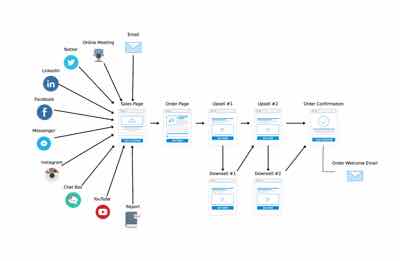
In the funnel above, the prospect who arrives on your landing page opts in by exchanging her email address for your gift.

Then, she purchases the first upsell and completes the cart checkout. Then, she upgrades on the second upsell after the checkout and go to the confirmation page without any incident.

Nothing ever goes that smooth.

That’s why the downsell was invented.

salesfunnels

And this is a funnel with an “error path”.

Notice the downsells in the funnel.

Downsells are the result of “What If?” thinking.

  • What if someone doesn’t take me up on the front end offer?
  • What if someone buys the front end but doesn’t take the upsell?
  • What if they take the downsell, what next?

See what I mean?

What do you want your prospect to do? You should know the answer to all the “What If” situations before you start building your funnels.

Really good product offers convert on the front end between 10 and 30 percent. That is a FANTASTIC conversion rate. What are you going to do with the rest of the people who don’t become buyers?

We need solutions for that situation as well.

Already, this feels like it’s getting complicated, right?

Before we go down this rabbit hole...  

What are the different kinds of funnels?

Once you understand that ALL funnels are variations of four basic types, you begin to realize exactly how simple funnels are.

So, let’s spend a little time going over these.

Strategic Funnels

You’ve probably never heard of Strategic Funnels. We’re one of the few trainers that talk about this. And with good reason.

To build a real business, everything needs to lead to your ultimate goal. And if you don’t know what that is, you can’t create a strategic funnel. This concept is so important that we have an entire course about the Strategic Funnel.

strategicfunnel

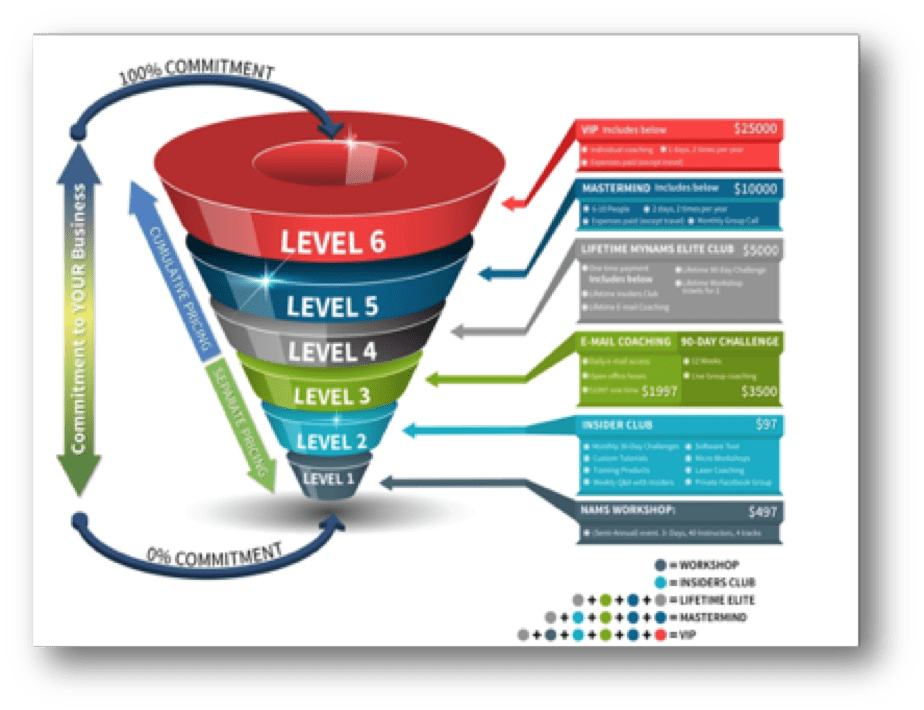
First, understand that the Strategic Funnel is your ideal vision of your business from top to bottom. Even if you have NO products, you can still create a PLAN for your business and layout it out in a Strategic Funnel.

There are three main elements in a Strategic Funnel:


  1. Commitment - Prospects and customers who display more commitment to themselves and their business enter the funnel from the top where the high-end (more expensive, more results-oriented) products live. Not-so committed prospects and customers come in the bottom of your Strategic Funnel where the lower-cost product live. We recommend measuring the commitment level in two ways.
    1. Mental Commitment - Use a survey to ask questions. One of those questions needs to measure their mental commitment to their business. People will say things like “Absolutely committed to success,” or “Failure is not an option.” But the second part of that measurement is probably more important, which is… 
    2. Financial Commitment - What are they saying with their wallet? Mental commitment is the road to frustrating failure until a customer realizes that they MUST invest in themselves and their business.

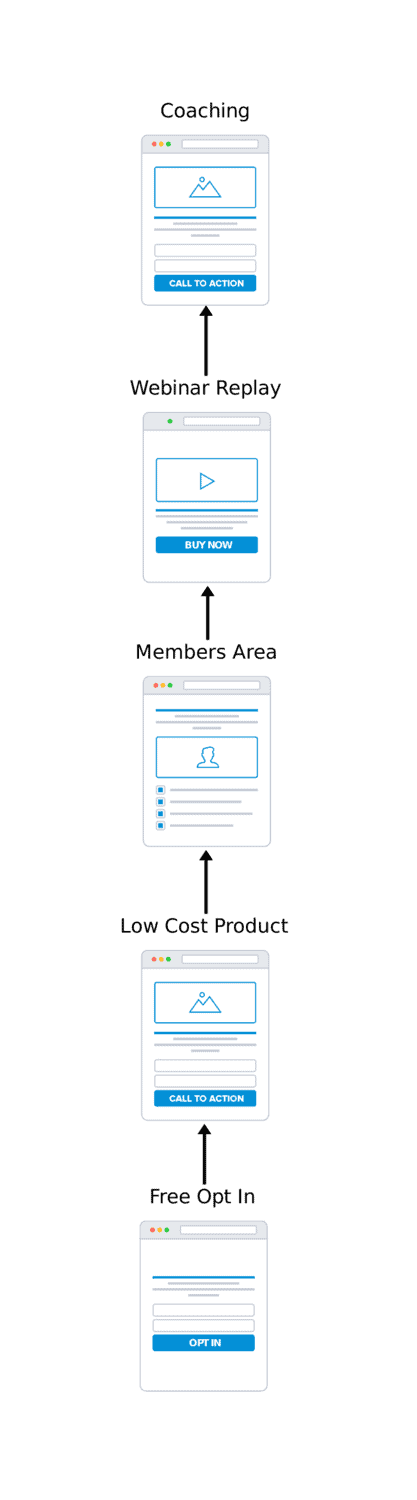
  2. Product Levels - While you can have as many product levels as you want, fewer levels keeps your business simpler and focus clearer. Product Levels that make sense is to make sure there’s a linear path from one to the next. For example, if your coaching program is the top level, then the free optin gift needs, low-cost product, members area, and webinar (if that’s your product path) need to lead to your coaching program naturally and congruently.

  3. Multiple Product Groups - We have 30 different lead magnets on different niche topics such as funnels, list building, blogging, graphics, social media marketing, Youtube marketing and many more. But all of them eventually lead to the ultimate goal for our business which is some kind of personal coaching. That can be one-on-one, group coaching or a weekend bootcamp. We like to think of it as multiple doors into one house. At the bottom level of the Strategic Funnel, we have many lead magnets in that product level. In the next product level, multiple lead magnets flow into fewer low-cost products to turn prospects into buyers. And the next level contains even fewer mid-level courses and products. And so on all the way to the top level where there is one or two high-ticket products - max.

The rest of the funnels we’ll discuss fit into the Strategic Funnel

Strategic Product Levels

Optin Funnels

This is the simplest funnel you can create. And I contend that it’s the most important.

Building your list is the most important thing you can do as an online marketer. Online information marketers in any niche with more than 100,000 people on their list can easily count on a six-figure income.

Opt In_ Free Product Funnel (2)

Business people with 10,000 people on their list and the ability to create funnels that convert can also count on making a good living with their list. I was a full-time online marketer with a support staff, full-time daily income and a dedicated following with less than 7,000 people on my list.

My friend Connie Ragen Green was able to create a $100k income with just 637 people on her list.

We had great funnels in place. But when we focused on the optin funnel, our business really took off.

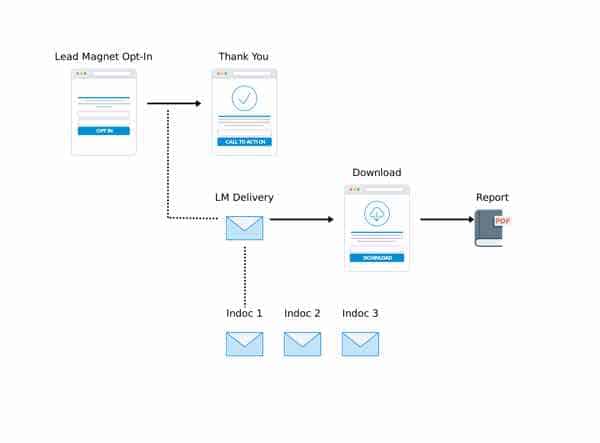
The optin funnel offers a high-value gift with a simple thank you page and a follow-up email series. Quality is everything. Don’t skimp.

Product Sales Funnels

Once you understand the optin funnel, the product funnel is easy. Basically, it’s the same principle as the optin funnel, but the product funnel is all about persuasion.

That means your initial sales page has to focus on benefits, benefits, benefits. And follow it with persuasion techniques that lead the prospect to the natural conclusion that they must have the product.

A product funnel on steroids continues the selling process as you add opportunities for the customer to buy UP your strategic funnel from one level to the next methodically.

Automated Funnels

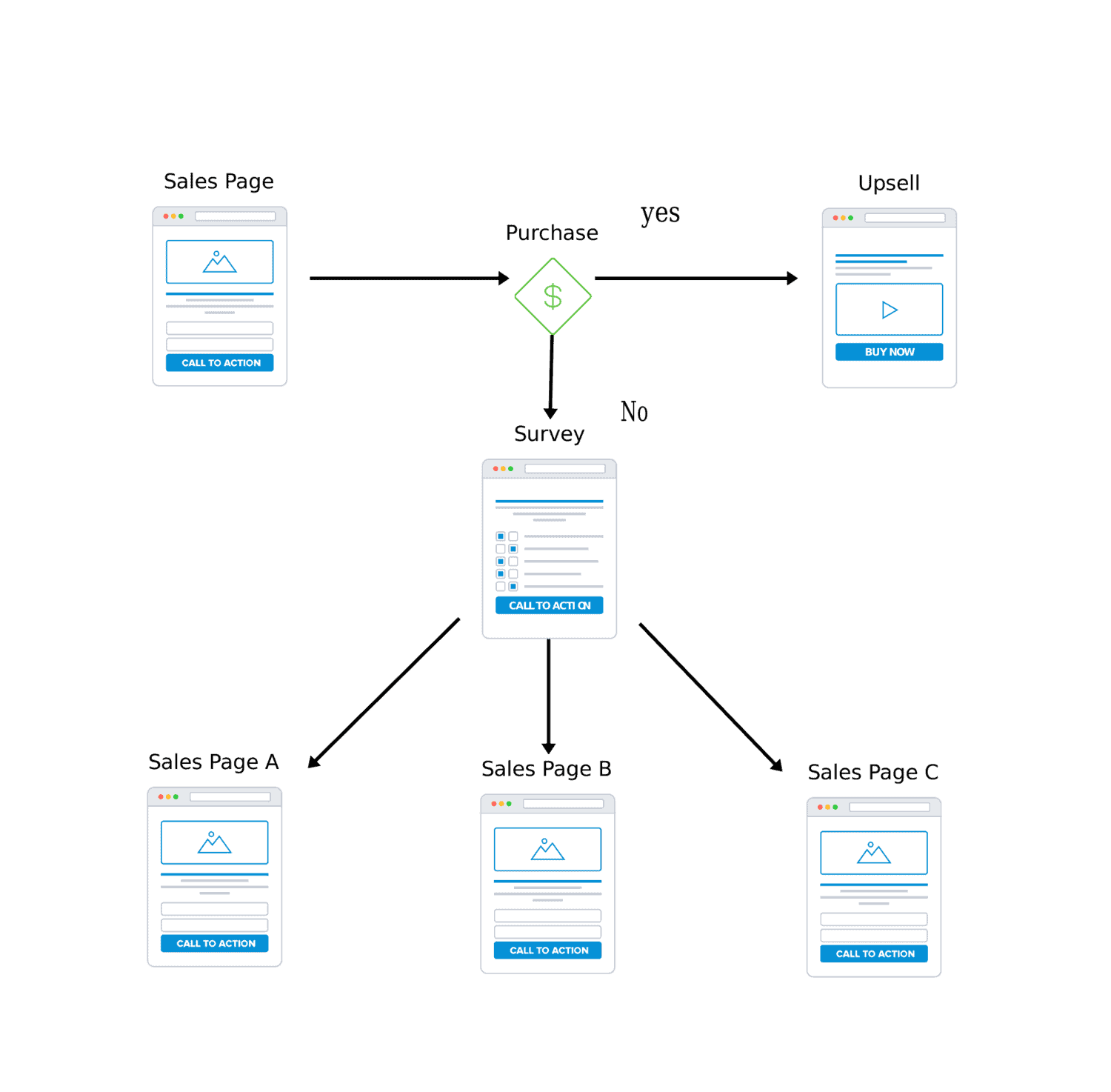
While automation seems complex, it’s not. An automated funnel responds to the buyer’s actions. It’s called behavior driven marketing.

Here’s an example on the right:

If a prospect comes to a sales page and makes a purchase, then he gets the upsell just as with any product funnel, but…

If the prospect does not make the purchase, then you send them to a survey tool to ask what their biggest problem is from a multiple choice survey. Of course, the solutions you are yours or affiliate programs you can promote.

Think of automated funnels as a choose-your-adventure results. Sometimes, your buyers will tell you directly what they want next, but more often than not you provide solutions based on their actions in the previous funnel.

Automated funnels take many forms. The goal is to keep the buyers and prospects in ongoing funnel opportunities.

Simple Automated Funnel

Start Simple!

If you don’t start with a VERY simple funnel, you’ll never build seemingly complex ones.

So, let’s break down the parts of a funnel. There aren’t many.

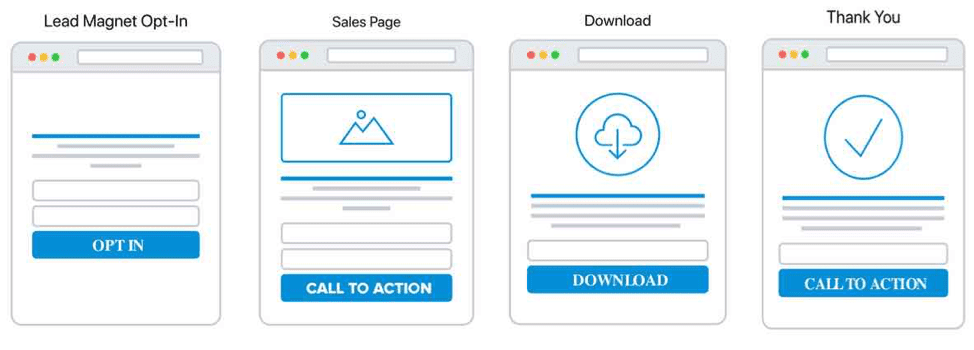
  1. Pages - this includes landing pages, squeeze pages, sales pages, confirmation pages and more.
  2. Cart - you must have the ability to take money when people want to give it to you.
  3. Autoresponder - communication is key. Whether the prospect buys or not, telling them what to do next is essential.

Pages

pages

There are essentially 4 kinds of pages classified by function.

The first is the optin page.

Everything you do for your online business is about building your list. We’re not going into it in detail, but the optin funnel is one of the most important funnels you can have in your business.

Your job as an online marketer is to fill prospect pipeline. The optin funnel is how that’s done. The best option is to get buyers, but even at 30 percent customer conversions, you’d still have 70 percent that you want to keep on your list to sell to later.

Constantly building your list is your primary job.

The second page type is the sales page.

A sales page convinces the prospect to pull out their credit card and purchase your solution that will solve their problem. That page can be a video sales page (VSL), standard long form sales page, hybrid sales page, or any other kind of sales page that works in your market.

If it’s doing its job, the sales page creation the trust relationship.

Nearly every page in the funnel contains an element of the sales page because you’re always selling. Even if you’re delivering a product, confirming their purchase or thanking them for becoming part of your community, you’re selling the prospect on taking more action.

The best online entrepreneurs get really good at writing sales copy.

Thirdly, we have the download page.

The primary function of the download page is to deliver the product. It can be a hidden page on your site, inside a membership or someplace else where you deliver the promised content.

It should always have some opportunity to upgrade (by the deluxe version). Your goal here is to be so valuable that the visitor wants more.

And finally, the thank you page.

Most people think the thank you page and download page is the same.

Big mistake.

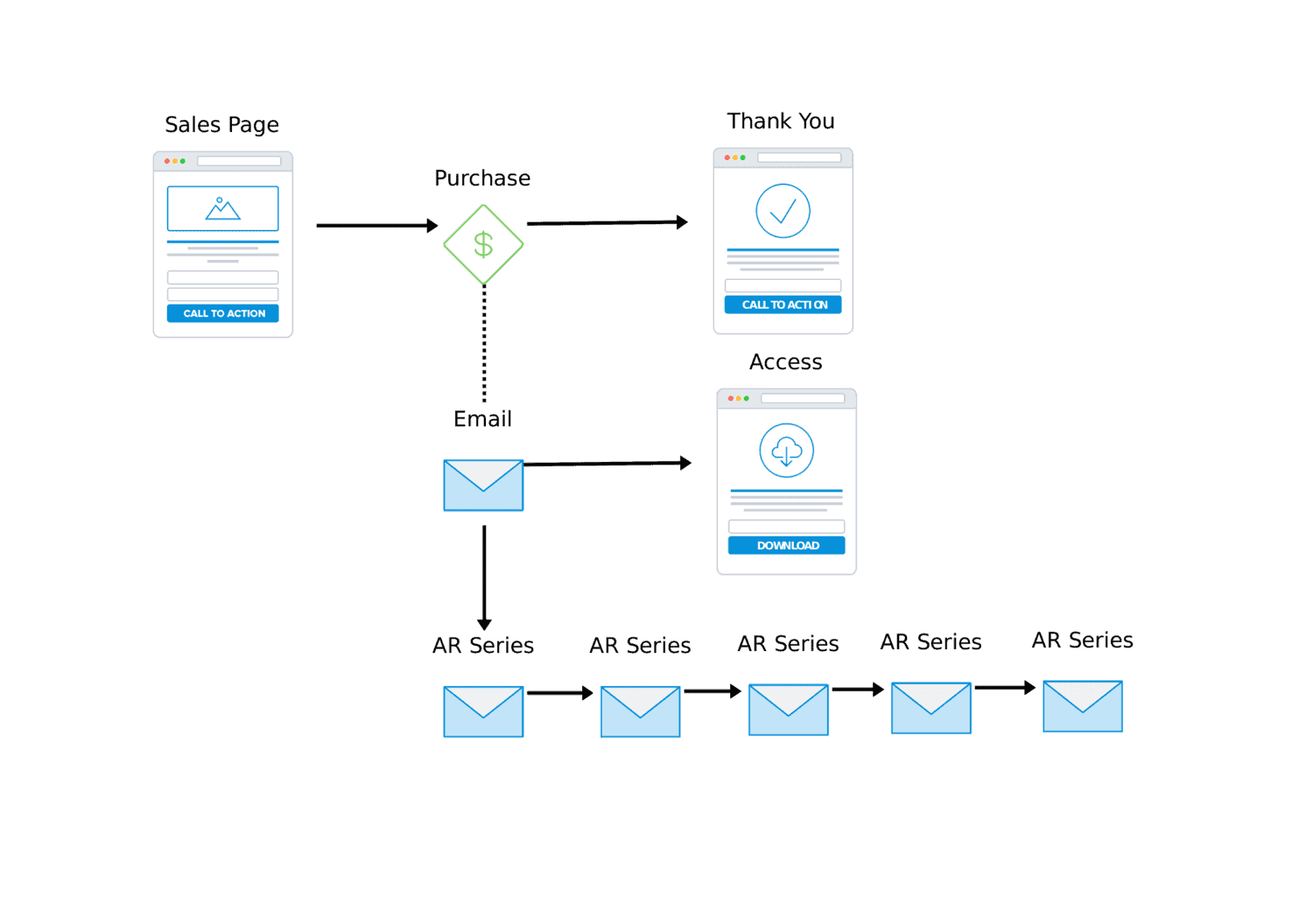
The only way to access the download page is through email. The thank you page is the page that follows the purchase, but does NOT deliver the product. But it may be the most important page in your funnel.

Think about it. This is the ONLY page that 100% of your visitors who have taken action will see.

This is the page that appears after you hit submit on the optin or sales page. So, make the most of it.

There are three reasons you NEVER deliver the product on this page:

  1. Ensure the visitor / prospect / customer gives you their best email address. It’s the one they check frequently, and the one most likely to be your communication channel.
  2. Set the expectations at the top of the page for next steps. For example, at the top of the page you might have something like, “Thanks for requesting our free report on XXXXXXX. The email containing your access information will arrive in your inbox in 5 to 7 minutes, but in the meantime, you might like to check out this course on XXXXXX.
  3. Display a sales opportunity on the page. This becomes a sales / thank you page hybrid. And will also become your best performing sales page. If you’re not adding a sales page below that heading, you’re leaving 30 to 70 percent of the money on the table.

Cart

There are many options for your cart from PayPal to Merchant Accounts to eCommerce platforms like Infusionsoft, 1 Shopping Cart, or Zaxaa. Which one you pick depends on the functionality you require.

Zaxaa offers really slick one-click upsells in the cart itself. PayPal as a cart does not.

We added the one-click upsell to our Infusionsoft system with custom code and that one thing lead to a 30 percent increase in revenue.

Choose carefully.

But don’t lose site of the most important functionality of the cart - collecting money and getting it into your bank account as fast as possible.

Autoresponder

Below is a simple 3-part funnel. There are 3 pages, one cart and one autoresponder.

Simple 3 part funnel

The autoresponder and email series is the secret sauce of online marketing. That’s one reason why we spend so much time talking and teaching about email campaigns.

Email (broadcast and autoresponder) account for about 85 percent of our revenue in some form.

In other words, if we didn’t communicate with our visitors and buyers via email, we would not be in business.

The autoresponder system should have the capability of responding to specific user actions. For example, in aWeber, we know that we can schedule an email this evening to go out to only those people who did not open the email this morning.

Autoresponder series are a little bit art and a little bit science.

You have to engage your readership with subject lines and exciting email copy.

But most importantly, the email builds the relationships with your prospects and customers unlike any other tool you have.

Pages, Carts and Autoresponders make up the key elements, but they each have the capability to make or break your funnel. So, you must pay attention to all the bottlenecks and fight the conversion fight.

Read your funnels

Every funnel has conversion points.

The conversion points tell you what’s working and what’s not working.

If you understand where the breakdown starts, you can fix those conversions one at a time. And your funnel begins performing better along the way.

It’s a long term process. And it involves many different parts of the funnel. But you tackle each one at a time.

For example, if you’re getting lots of traffic to an optin page, but few people optin, you have a landing page issue. Improve the landing page, and if the optins improve, you’ve solved that conversion point.

Next, if quite a few people are taking your optin gift, but not buying your low-cost product on the thank you page, you’ve got a problem on the thank you page. Improve the offer or the copy, and if the conversions improve, you’ve fixed the conversion point.

Every conversion point has to be monitored from front to back of your funnel so that you eliminate all the bottlenecks.

This is where the work comes in creating and managing funnels.

But first, you have to create the funnels… now.

Get started with funnels fast

10 Profitable Funnels Package-300

Creating funnels have a lot in common with writing.

If you’ve never created funnels, you start with a blank page. And in writing - or funnel creation, a blank page is the most daunting obstacle to accomplishing what you want.

That’s why we HIGHLY recommend funnel templates. We’ve identified 10 funnel templates that everyone should have in their business.

And creating those templates from scratch is ridiculous when you can start with a template.

You can grab these here and get started immediately implementing the most important funnels in your business.

YES, I Want 10 Profitable Funnel Templates So I Can Get Started Now!

Category: Exclusive Content For Members

  • 1
  • 2
  • 3
  • Next
dd-sidebar-ddvertical-1

Sign In >

Popular Posts

NAMS Funnel Revealed
Discover the 3 Sales Funnel Stages that Everyone Must Use to Become Profitable Fast!
Your YouTube Marketing Strategy with 5 Easy Tips
How to Increase Traffic Through Social Media
Use Pinterest as a Marketing Tool: 9 Ways to get More Traffic and Sales

About NAMS

The Novice to Advanced Marketing System is a step-by-step system focusing on Team, Training and Tools to help novice to advanced business people build a Simple, Scalable and Sustainable business.

Other Related Content

5 Affiliate Marketing Strategies that Convert Like Crazy

5 Myths of Affiliate Marketing | Affiliate Marketing For Beginners

5 of the Best Affiliate Marketing Tips

5 Passive Income Business Ideas

Affiliate Marketing Roundup – 02/13/2011

  • Help Desk
  • Contact
  • Support
  • Privacy Policy
  • Earnings Disclaimer
  • Legal Notices
  • Membership Agreement
  • TOS
  • Testimonials
  • Affiliate Disclosure

Copyright © 2025 · MyNAMS.com · All rights reserved
NAMS, Inc. 203 CR 890, Etowah, TN 37331 USA

Disclosure: Some links on this website may be affiliate links. If you make a purchase through one of our affiliate links, we may earn a commission.
We only endorse products and services we use or trust.