Novice to Advanced Marketing System

NAMS | Building an Online Business to Support Your Dreams

  • Home
  • Product Catalog
  • Free Resources
  • Affiliates
  • Support
  • Blog
  • Masterminds
    • NAMS 90 Mastermind
    • Affiliate Sales Dominators Mastermind
    • Idea To Income Mastermind

What do you stand for?

By David Perdew 2 Comments

“What Do You Stand For?”

Knowing the answer to this question can energize your life and your business for the rest of your days.

It can be the difference between success and failure…

Last week, an inspirational quote image scrolled through my Facebook newsfeed. My good friend Cathy Demers had shared it.
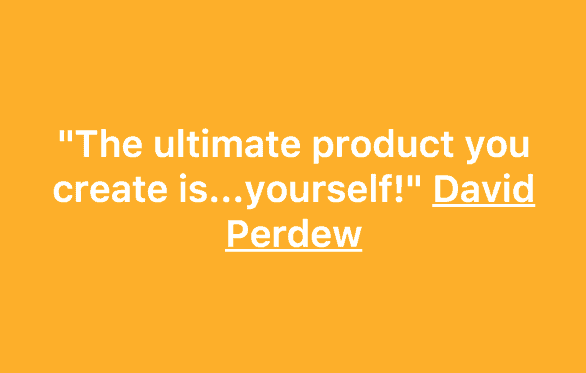
I read it and thought, “That’s pretty profound!” And then I saw the attribution.

It was something that I had said during my interview with her. It was my quote:

“The ultimate product you create is…yourself!”

I probably heard that somewhere else, I’m sure. Who knows?

But I started thinking about that. It’s really very true. If we’re not creating our best self, we leave our best product on the shelf.

Of course though, it’s the hardest job we can have, and with the least tangible ROI, so…

We focus on strategies and tactics until we work ourselves into a quivering frenzy of activity, adrenaline rushing through our veins until we squeeze out the last nickel from our latest email promotion.

That same stimulant keeps our brains buzzing through the night as we stare wide-eyed at the ceiling pondering the next big promotion. What’s it going to be?

Like Sisyphus, we’re pushing that rock uphill, only to get to the top and wonder why?

(Don’t know Sisyphus? In Greek mythology, he was the king of Ephyra and was punished for his ‘self-aggrandizing craftiness and deceitfulness’ by being forced to roll an enormous boulder up a hill only to have it roll back down every time – for all of eternity!)

Self-aggrandizing. Self-absorbed. Selfish.

There’s a funny thing that happens though

As we begin making more money, and achieve more success, a hole in our stomach gets bigger and bigger, and we can’t quite fill it with the normal activities.

Money, work, big promotions – none of that seems to gets the juices going any longer.

And it’s because we are a little bit lost.

If you haven’t experienced this yet, you probably will at some point, especially as you begin adding the years.

It may show up as the blahs… nothing is really wrong, but there’s nothing really right either.

We begin questioning why we’re doing what we’re doing. And everything else too!

About this time, other people begin questioning our motives too.

That’s because we’ve lost our connection.

In my middle years, I saw something astounding in myself after a few well-deserved personal calamities:

Whenever I began feeling too important, a fall was just around the corner. Always.

The symptom that preceded the debacle was judgement, judging everything and everyone.

The problem with judgement is that it separates me from everyone, the people I love and the people who rely on me in my business.

People get hurt.

When that happens, I have to mash the brakes, come to a dead stop, and regroup.

The best way to do that is to reach back and ask myself, “What do I stand for?”

With that question, I’m touching the reactor core. I’m getting at the heart of the matter. I’m relieving the pressure and getting some much needed perspective on how I’m really doing.

With the perspective comes less stress, better blood flow, and calmer physical and mental systems.

But most importantly, my ego gets a good dose of rightsizing.

You see, that’s where the trouble is. Our ego wants to protect us. Staying safe usually means that we don’t make big changes. We don’t jeopardize the existing system, so it wants us to keep doing what we’ve been doing, even if it’s wrong.

Essentially, we can’t trust the ego.

The ego doesn’t care two cents what you stand for! The ego stands for itself, nothing else. Until we take charge of the little voice holding us back, we never progress. We give up. We fail – without learning. We cave into fear.

Remember earlier when I mentioned the least tangible ROI?

The return on investment (in yourself) is slow going. And it may even seem like a waste of time because it’s a lot of work doing self-discovery. And it’s not for the faint of heart.

But there are business benefits galore that come from answering the question: What do you stand for?

First, we need to make an assumption. And that is that you’re building a long-term, community-based group of prospects and buyers that you actually want to turn into evangelists for your brand. You like these people and you want to hang out with them.

That single goal implies that you want people who will identify with you, your expertise and your beliefs. In other words, they are more like you than not, or at least can identify with some of your beliefs.

With the assumption that you’re building a long-term business community, two things are really important:

  1. Identifying, targeting, and engaging with your ideal client. Often, we speak of building your customer avatar as the key to building a community that buys your products and enjoys knowing you. This is where the LIKE part of “Know, Like and Trust” becomes especially important.
  2. Sharing points of view. Shared attitudes, shared beliefs, shared goals – all of this comes from the person running the community. Without the commitment to transparency and actually building bonds with community members, the community will flounder along.

This sounds very risky…

It is. The risk is that you’re going to offend someone. And of course, you will. In fact, you must.

We don’t mean to offend anyone intentionally, but by answering the question, “What do you stand for?”, you can’t help but alienate some people who have completely opposite beliefs.

That doesn’t mean it has to be unfriendly or unpleasant. In fact, evidence from the 2016 U.S. election to the contrary, people can have robust discussions about difficult topics and still be friends.

And with that, often comes a lot of respect.

But the people who become your evangelists, your best partners, buyers and promoters, are those who LIKE you the most.

If they don’t know you, they can’t like you.

There’s a quote by Ernest Holmes, a New Thought leader from the 20’s through the 70’s who did a speech in 1959, that has always rung true to me:

“Find me one person who is for something and against nothing, who is redeemed enough not to condemn others out of the burden of his soul, and I will find another savior, another Jesus, and an exalted human being.”

For something and against nothing…

Wow, now that’s a really amazing concept. I said earlier that judgement is the beginning of my downfall, so I’m obviously not there, but I certainly try to come at everything from the “for something” viewpoint.

Often, it’s just a difficult perspective shift.

“Being for something and against nothing” indicates that you’re willing to bring a solution to the table instead of pounding on the problem.

When I ran projects for a major telecom, I had a rule: Don’t bring me the problem until you have a solution.

So, here I am! What do I stand for?

First, I have strong beliefs about politics and religion. Neither of those really define who I am and why I do what I do though. They’re just opinions. Everybody’s got opinions.

Nothing makes my opinions better than your opinions. If you want to persuade me that your opinion is better than mine, come armed with facts that can’t be disputed.

What I stand for is more than an opinion. It’s a guideline. A rule. These are things I believe that guide my life.

Your job is to figure out what you stand for, claim it, and voice it. Don’t be shy. Hiding your light under a bushel as the old proverb says is doing nobody any good.

Here we go. I stand for:

Hope

Hope is the driving force behind everything, I think, but you have to understand what hope is and what it is not.

Often, people will poo-poo someone who talks about hope with comments like, “Hope is not a business plan.” That’s true, but if you don’t have any hope to begin with, the business plan never gets off the ground.

Hope is not a substitute for action. I can hope for a peanut butter and jelly sandwich, but unless I get up, get the ingredients, and spread it on bread, it’s going to be hope misplaced.

We live in a society of personal responsibility. We’re all accountable for our progress. Hope is the first step. It’s the dream. Dream becomes reality only through action.

Love in my life

I’m not talking about lust or sometimes-when-I-get-what-I-want kind of love, but the kind of love that never goes away and puts a smile on your face every time you think of that person.

It’s not the kind of love that has strings attached. But it’s also not unconditional. There are boundaries.

My wife and I have discussed those boundaries and set them in stone. If one violates the boundaries, the relationship is in jeopardy, and trust is broken.

And we have the commitment to work at the love within the boundaries. Together.

Family
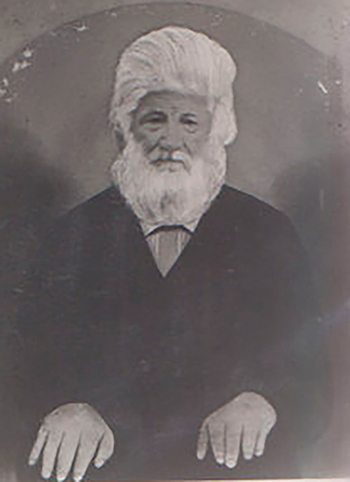
My 3rd Great Grandfather – I got the hair 🙂

Kids, parents, aunts and uncles – what a pain in the rear… But what a great joy too.

I was a great dad when my kids were very young. Then, as I became too important, I turned into a terrible dad. And now, I hope I’m a much better dad because of that experience.

It’s the same with my parents: Not such a great son, but now much better. My perspective has changed and so has my commitment to them.

Family, to me, is THE Legacy. When I’m gone, they will still be here. Today, we leave behind video, pictures and writings. People doing genealogy research in 100 years will have the benefit of looking through the Facebook archive. Oh my!

What will they see?

Having gotten involved heavily in my own family history all the way back to 1500 in England, I’m discovering the legacies others have left me include the good and the bad. Now, it’s another opportunity for me to evaluate who I want to be.

Simplicity

This is extremely hard for me.

I’m a problem solver. But I’m also part Rube Goldberg – look it up. I can build a mousetrap that is so complicated people have no idea that a mouse was ever involved.

The hardest part of my daily life is to keep it as simple as possible so I can do the most good with the resources at hand.

Keeping life simple improves all aspects of the other things I stand for. But occasionally, I like to just jump in and stir it up a bit too – bit of a chaos junkie I’ve been told.

Money

I like money. I like having money. I like giving money away. I like everything about money.

My belief is that money is nothing but energy in paper form. It’s a tool that allows us to impact the world. I don’t expect that I’ll die with a lot of money because I love to live. And as long as I can walk and breath, there’s a lot to do, many people to help, and great causes doing great work.

Money helps with all that.

And let’s face it, life is just so much easier when you don’t have to worry about money.

The management of money is a completely different animal. Everyone needs training in creating and managing money and not letting it manage you.

Travel

When I was a kid, my family loaded up the big station wagon, strapped on the car top carrier stuffed to the gills with traveling stuff, and headed cross country.

We went to the Grand Canyon, Washington D.C., and Florida among others.

When I was 15, my parents scraped enough cash together to send me on a 21-day, 9-country European school tour. It was life-changing and began my love of other cultures.

From there, I ventured to China, Peru, Ethiopia and many others. Third-world travel became my favorite thing to do. Whenever I came home from a great trip, two things happened:

  1. I was truly grateful for being a U.S. citizen
  2. I understood people in another culture a little better only to discover that they were very much like me with pretty similar goals in life

Travel is the great doorway that allows us to embrace other cultures we don’t understand.

Business

This is pretty obvious, but I believe in business. But maybe not for the reason you would suspect.

You see, I think business is a diplomatic tool and can be used to bring peace. One thing I learned from world travel is that everyone has a business, whether it’s selling goods in the weekly market in China, having a small coffee stand in a rural Ethiopian village, or renting your burro for transportation in the Peruvian mountains.

Business drives the world.

When people do commerce with each other, they’re friendlier and more understanding. And when everyone can feed their families, the tension in the world is reduced.

And business is incredibly creative. Since it’s all about problem solving, there’s a new challenge every day.

The solutions can be as imaginative as the customers will allow.

Oneness

I started to say “environment”. Then, I thought I should include “spirituality”. And I really thought “respect” deserved to be on this list, since that can be the basis of all relationships.

But when I looked more closely, the word that comes up is “Oneness”. In fact, it seems like a common thread throughout this piece.

We are one. When we’re not one, we’re in conflict. It’s as simple as that.

Being one with the environment means respect for land, nature, animals and the earth. It means respecting ourselves and our descendants enough to be great stewards of the world around us.

We don’t over fish, over hunt, over drill, over pollute, or anything else that could be too extreme unless we want it all to be “over”!

Being one with our community means that we are a part of, not a part from. It’s about contributing and pitching in. That can be anything from being a volunteer fireman to serving (or just supporting) the school’s parent/teacher organization to serving on the city council to picking up the trash on the road. (And hopefully, helping others see that throwing trash on the road is hurtful to all.)

Being “One With” is committing 100 percent to the group.

Start with a small group – maybe your family – and soon we realize we’re all part of a much bigger group that covers the planet.

Service

And it finally comes down to this.

I stand for service – helping others in the best way possible. I can always listen and be a friend in my small groups, but even in the larger groups like my online communities, we can help in any way possible and reasonable.

We’re here to serve.

Now, it’s your turn.

Hopefully, when you’re building your business, you’re focusing on what you stand for and bringing your special skills to those who want to be your evangelist. Start by sharing what you stand for and attracting those like-minded people as soon as possible.

Come over to the MyNAMS Facebook page and comment on this blog post to tell us what you stand for?

It’s okay. They won’t bite.
Category: Featured Content, NAMS Notes, Productivity

Testimonials – How to Let Your Customers Do Your Selling FOR You

By David Perdew 2 Comments

Testimonials – How to Let Your Customers
Do Your Selling FOR You

The difference between testimonials that work and those that don’t is one word: Believability

You know about testimonials – those little blurbs from customers that tell prospects how great a product or service is.

The headline and blurb at the referral engine platform Influitive says it all…

pasted image 0

Happy customers are your BEST salespeople.

Did you also know that over 70% of customers look at product reviews before buying? And 90% of participants in a Zendesk survey say they were influenced in their buying decisions by positive reviews.

According to research firm McKinsey, customers that come in through the advocacy of other customers actually stay longer and pay you more over time.

And it gets even better, because according to Influitive, customers who advocate for you will actually stay longer and pay you more.

Advocates and Advocate Marketing?

Those are relatively new phrases getting a lot of attention because of statistics like those above and these:

  • Word of mouth is the primary factor behind 20% to 50% of all purchasing decisions. (McKinsey)
  • 63% of consumers search for help from other customers online. (Lithium)
  • Brand advocates are 70% more likely to be seen as a good source of information by people around them. (BzzAgent)

Advocates can be affiliates, but they are so much more… and when an advocate evangelizes enthusiastically about your business on social media or through testimonials, prospects pay a lot more attention.

The first step in building advocates for your brand is to give happy customers the best opportunity to shout your greatness from the rooftops. That’s called a testimonial.

And even though advocacy goes way beyond testimonials, without that you’re dead in the water.

But getting testimonials can be a problem

Business people don’t want to ask for them or don’t know HOW to ask for them. And customers, while they might want to give them, don’t know how.

They actually may be a little afraid to give you a testimonial because they’re only 90% positive about the experience.

I’m going to show you why that’s the PERFECT start to a great testimonial

We’re going to show you exactly what to ask to get testimonials, how to use the testimonials to overcome the biggest objections of your prospects, and even how to get testimonials without asking.

First, let’s talk about the elephant in the room – that is, the problem with 90 percent or more of testimonials out there right now…

“I don’t believe it!”

The problem – and it’s a big problem – with testimonials is they tend to be too sugary. Too positive. Too… unbelievable.

“Since I bought the ABC Super Scooper Money Making Machine, I’ve made so much money I dumped my wife of 22 years and I married 18 year old supermodel triplets. I now own 16 homes, 83 cars and my own personal rocket ship to Mars. Plus my skin rash cleared up real nice and I’m about to buy a big yacht and an island and become president of a South American country. Let me tell you, that was the best $19.95 I ever spent!”

Yup. Uh-huh. You believe that, don’t you? Me neither.

Testimonials are a lot like resumes…

What happens when you hand your snazzy jazzy resume to a hiring manager? Sure, they read it. But do they BELIEVE it? Nope. If they did, they wouldn’t do all that digging into your past, your social media accounts, your previous employers, your college records and your references.

Why don’t they believe what they read in resumes? Two reasons:

  1. A lot of people ‘pad’ their resume, making themselves sound better than they are. And since they don’t know you, they just have to assume you’re padding until proven otherwise.
  2. It’s all positive. Nearly nobody ever puts anything negative on a resume. “That company canned me because I didn’t do a darn thing for 8 months but play video games on the computer and play with the company dog.” You’re not going to see that on the resume…

And what does this teach us about why people don’t believe testimonials?

A lot of testimonials are fake, or are they?

It really doesn’t matter because nearly everyone BELIEVES they’re fake.

So, the real job of a testimonial is to overcome the distrust factor, to tell the story about the relationship with the brand in a real, but positive way in just a couple of sentences.

In other words, it has to be some of the most persuasive writing on your sales page.

Readers see all positive testimonials and immediately flip into disbelief.

So, how do you get real testimonials that people BELIEVE?

By getting believable testimonials. (I know, that’s a little chicken and egg, but stick with me just a second and it will make more sense.)

Let’s tackle the big question.

What makes a testimonial believable?

If the testimonial starts out on a negative note, people’s defenses go down and they your credibility goes up. In fact, not only does a bit of negativity ring true and become believable, but there’s a second benefit as well:

If the testimonial starts out negative – just a little, people are drawn into it from start to finish because we all like to see what happens next. A slightly negative review that turns positive becomes a believable story with a solution.

For example, if I were to write a testimonial for MyNAMS Insiders Club as a member only (yes, I know – I own it, so right away I’m at a disadvantage), I would start out like this:

“When I first heard about the MyNAMS Insiders Club, I thought it was too good to be true. And when I stumbled around in the resources library, I was so lost because there was so much, I thought I’d wasted my money. But once I realized this is not just an average superficial training center, but a full library of updated tools and training on any business topic that I can use for life whenever I need it, I was completely blown away…”

So, let’s break it down.

The first two sentences are pretty negative, but they get to the biggest complaints we have about the Insiders Club: 1) We’ve built a training system at a price that seems to be too good to be true, and 2) there’s so much material that people get overwhelmed very quickly.

The key point is that I put those issues out there right away. Those objections (which are ones EVERYONE will have when they’re visiting any sales page) are recognized and CONFIRMED immediately.

Then, in the reversal, I show why I was wrong, or overcame the issues, and was positively affected.

Another example:

Let’s say a friend is recommending an auto mechanic to you. The conversation might be like this:

“You know that repair shop on 5th and Vine, the one in the tacky yellow building? Well I went in there the other day because something was wrong with my car.

The place came highly recommended, but I gotta tell you when I walked through the door, I wasn’t too sure. It didn’t look nearly as modern as the repair shop at the dealership.

But they took great care of me and my car. They diagnosed the problem in minutes, told me exactly what was wrong and how long it would take to fix it.

It cost way less than I thought it would, and they had me back on the road in 40 minutes. I was so impressed.

The last time I went to the dealership they tried to upsell me on a bunch of stuff and I know they overcharged for what I let them do. I’ll never go back to the dealership again.

That repair shop might look a little funky, but the mechanics are top notch, fast and friendly, and they don’t try to rip you off.”

Notice how different this testimonial is from most of the testimonials you see online. This one starts out negative, talking about “the tacky yellow building,” and “it didn’t look nearly as modern as the repair shop at the dealership.”

And near the close it gets negative again, saying “That repair shop might look a little funky.”

But there is no doubt the author of the testimonial is thrilled with the service he received and the price he paid.

THIS is a testimonial people will believe.

In fact, if you have several of these kinds of testimonials, half your job of selling will be done for you.

That’s because your customers will be overcoming prospect’s objections for you, in a way you alone could never do.

Just imagine, you haven’t written one word of your sales letter or sales video yet, and you already have half of your selling done.

How sweet would that be?

Good testimonials help with targeting too…

This is a really important point and often overlooked.

A great testimonial pushes people away who are not a good fit for the business offer as well. That’s important. The wrong people in your business can suck up a ton of time and resources and will NEVER be happy.

Look at the repair shop again.

Some people don’t mind paying double or triple prices if they don’t have to sit in a “tacky yellow building” while waiting for their car repair, but instead get to sit in a nicely appointed waiting area with wi-fi, cable TV and a coffee machine.

If you’re the kind of customer that values ambiance more than money, the tacky little repair shop is not for you. That testimonial just saved the business from having to deal with an unhappy customer.

Here are 3 more tips on getting and using testimonials…

1: Testimonials that are rich in detail are more believable.

For example, “I love the bigger dials on this stove” versus… “The dials are almost twice the size of the older model, making it much easier for these tired old eyes to see the settings. Because of this, I no longer burn my eggs and my wife no longer complains about having a burnt smell in her spotless kitchen.”

2: “Interesting, tell me more.”

If you are speaking to a customer, use the above phrase to get them digging deeper and telling you more about their experience. Also, anytime you’re getting feedback by phone or in person, remember to ask only open-ended questions. This will provide you with much more information than simple yes/no questions. And of course the same applies to written feedback – ask only open-ended questions.

3: Name and website

When asking to use their feedback as a testimonial, be sure to tell them you’ll be using their name and URL if they have one. This is free advertising for their website. Who doesn’t love that?

Let’s look at a couple of real examples for some of our products

MyNAMS Insiders Club

http://nams.ws/trial

When someone makes a lot of progress, you want that person to talk about their success and their process. Often, customers don’t do it because they don’t value their accomplishments enough. Jeff does a nice job of starting from a dubious place and showing how he followed the process through to success. The objection he’s overcoming right away is the question, “Is this is a get-rich-quick scheme?” Right away, he talks about a 12-month investment of time…

“I came into NAMS Insiders Club three years ago through the list building challenge. I fell in love with the monthly challenges. That year, I took every challenge. I accomplished every challenge in 12 months straight.

At the end of the year, I had the beginnings of a real business. I came into NAMS really with a hobby, not really a real business. I really didn’t know the first thing about building an online business. I had taken some courses in list building and things like that, but really knew very, very little. By the end of the year, I had 12 things that I should be doing in my business every single day that helped me to build my business.

What I enjoy now, two years later, is the weekly live calls where Jennifer and David get on and they show us what they’re doing in NAMS. How they’re running their own business. What I really appreciate about that is that they share with us the things that work, but also the things that don’t work. They share how they measure things. Then how they make changes and adjustments when things don’t go according to plan or aren’t as successful as they hoped they were.

It really helps me because I’m not in the internet marketing niche. I’m in the Catholic education niche. A lot of the things that work for a lot of marketers don’t work in my niche. They don’t work for my audience. By watching David and Jennifer, I can choose what I want to try. I can learn from their example of how to measure my success, then how to make changes when I don’t meet with success. I’m able to apply what I’m learning to my own audience and to my own business. That’s really really valuable.

Join the MyNAMS Insiders Club. You will find a great community of business people who support each other. You’ll find great education. You’ll find value year after year after year.”

Jeff Arrowood, FromTheAbbey.com

Camp Clarity

http://nams.ws/clarity

I like this testimonial from Mitchell Cohn because he sets the bar for the amount of effort and seriousness required for the Clarity program to be successful. He says straight up that the objection may be that it is “one of the most difficult things” he’s had to do. People who don’t take the course seriously are never satisfied with the outcome. Those who do are very satisfied. So, we want to make that clear from the beginning. He does. And then he talks about the benefits of doing that.

“Wow, David. I’ve just finished Camp Clarity. The course was well-named. I think that was one of the most difficult things I’ve ever had to do. If you’re as serious as I was in wanting to know where you’re headed and WHY, this course really makes you think – and takes a significant amount of fortitude, insight, and mental energy.

I have to admit that where I ended up is NOT AT ALL where I expect to be. I’ve also learned that lying to one’s self is a lot easier than facing the truth and working through some difficult issues. The end result, though, is well worth it. I have a clear end in sight. I have clear vision for the businesses I wish to create and a roadmap to get there. Thanks for this roller-coaster ride.

I’m on to my next quest, 12 Steps to Building a Better Business, which is, I believe, what both you and Jen have suggested.”

Mitchell Cohn

Monetize Your Life With Storytelling Workshop

https://nams.ws/storytelling

This was an email that came into Cathy Demers who had hosted me on a webinar about the Storytelling Workshop.

“Hi Cathy,

Thank you for hosting David Perdew today. I really liked the exercise of listing your everyday events and finding the universal truth.

I’m the head of the nominating committee here in my senior center (I’m 83) but I realized I could use that hook (step 1 in the process) to talk about non-participation, entitlement, how a leader has to have patience and understanding along with organizing skills, and about dropping out of a tribe that’s no longer serving your interests. I could write a whole series of ‘lessons’ from that one experience.

What a gift to help me see those possibilities.

I LOVE this.

Please forward this to David with my thanks.

PS: You know, we never know when one idea will start a large reaction. I’m a prolific writer and podcaster and this one idea will help me touch more lives. Thank you both.”

Cara

I love this testimonial because right away she throws out what would be an objection for many people – she’s 83 – and definitely undaunted because she dove right in and got results right away.

This testimonial was much more of an email of appreciation that a pre-conceived testimonial, exactly the kind of endorsement that drips with sincerity.

Category: Featured Content, NAMS Notes

The 5 Mistakes That Guarantee Your Business Never Gets Off The Ground – Part 2

By David Perdew 1 Comment

“These 5 Pieces of REALLY Bad Advice That Cripples ALL New Online Business Owners … UNLESS You Discover the TRUTH Before It’s Too Late!”

If you haven't read Part 1 of this 2 part series, be sure to catch it first here...

Part 2 of 2

I got on a roll in Part 1 of this series taking on all the $27 gurus out there who grab your money and run with the latest ‘secret loophole’ or ‘hack’!

The MyNAMS Insiders Club members love it when I do that. They know we have their best interest at heart. We do everything we can to protect our community from the nonsense out in the marketing world.

We also make sure that we introduce our members to really good people with high integrity that believe in our #SellNoCrap mantra by providing real solutions to real business problems.

And there are a bunch of great folks that fall into that category.

What’s our goal in building a community like the MyNAMS Insiders Club?

Frankly, I get a little bashful when I talk about the Insiders community.

Someone asked me today which I like best: Working with new entrepreneurs, high-end coaching clients or building products.

My answer surprised them. I LOVE working with our Insiders Club members. It’s the community! It’s the honesty and the support that we give one another.

If you haven’t found a community of like-minded people who are doing what you do, I invite you to give us a try. One dollar gets you in the Insiders Club for 14 days. Then, you can decide if it’s right for you.

I mentioned in Part 1 that the Insiders Club is like the business behind the glass wall. All the Insiders watch as we figure out what’s working today and in the future for the long haul.

What we teach and what we preach is from our experience. Every week, on our live mastermind call with the Insiders, we review our experience in our business, and share what’s working and what’s not working from our members as well.

We root out the really bad advice that stinks up the Internet, and try to be a guiding light for the new or experienced marketer to get on and stay on the right path, right away.

Let me tell you, it’s a full-time job. There’s a ton of really bad advice out there. It’s tragic too because following bad advice causes you lose momentum, time, money and hope.

It’s hard to recover from that.

That’s why I decided to tackle the worst of the bad advice in this 2-part series. In Part 1, we focused on the two worst, and most common, pieces of bad advice to guard yourself against:

  1. Create your product first
  2. Get more traffic

In Part 2, I’m focusing on these other seriously flawed pieces of advice:

  1. Focus on your passion
  2. Get the money and get out
  3. Get your Infrastructure in place first

Bad Advice #3: Focus On Your Passion…

Here’s a disclaimer.

I wholeheartedly believe in this philosophy. I teach it. I preach it. 

But there’s a second part to this that has to be considered: How is your money situation today?

If you’re panicked about paying your electric bill today, telling you to follow your bliss and focus on your passion is a real disservice.

Your passion at the moment is to get enough money to pay the electric bill!

And, as a business coach, I’m an idiot if I don’t recognize that.

There’s two parts to a passion-based business. And by the way, I LOVE passion-based businesses because when you love what you’re doing, chances are that you’ll do it for a really long time and successfully!

Most people who start a business are reacting to some force in their lives. Here are some examples:

  • Down-sized or laid off or fired
  • Medical ailments restrict what you can do
  • Incredibly unhappy working for the man
  • Very passionate about a cause or a process
  • Control freak who doesn’t trust anyone or any institution to be there for you
  • Entrepreneurialitis (I made up that word) which presents itself as an extreme freedom seeker

All of these have one thing in common: Transition.

Every entrepreneur I know started their business while in some form of transition. And transition, by definition, is a state of flux which can be very stressful.

So, the two parts of creating a passion-based business are:

  1. Triage - how to stop the bleeding quickly? Every person in transition needs to reduce the stress as fast as possible. Often, that means building a system to create money fast to alleviate the financial stress as well as a support group to prop you up and guide you through the personal stress that appears when friends and family tell you that you may be a little crazy for starting a business. (I have an aunt who still tells after 12 years of online business, “I just wish you’d get a job.”)
  2. Long-term prognosis - now, that you’ve stopped the bleeding and reduced your stress, how do you build a business that feeds your soul, one that you can love a long time?

So, when you hear teachers (like me) say, “Follow your passion,” make sure you are past the triage stage of your business life.

Always keep your passion in front of you. But reduce your stress first so you can survive.

Why is focusing on passion AND money so important?

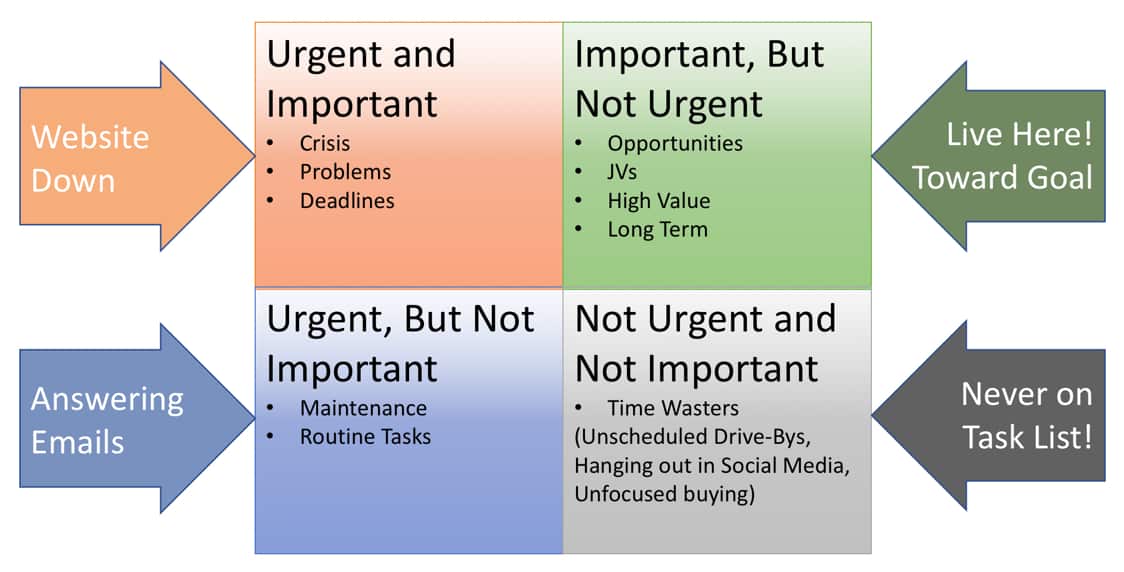
There’s a little thing called the Important / Urgent matrix. It’s one of the best reminders for what you should be working on at all times.

UrgentImportantMatrix

You’ll notice there are four quadrants:

  1. Urgent and Important
  2. Important but not Urgent
  3. Urgent but not Important
  4. Not Urgent and not Important

I won’t go into this in detail. We do that in the Insiders Club. But I will point out that if building a business around your passion is your IMPORTANT goal, then paying the electric bill is the URGENT.

Once the Urgent and Important needs are met, you want to live in as much of the Important and not Urgent world as possible because that’s where your growth and happiness is sure to live.

Never focus on your passion without taking care of your basic needs first. Huge mistake. But you want to focus on your passion as much as possible.

Bad Advice #4: Get the Money and Get Out…


This is just horrible advice.

We all want more money, but getting money at any cost is one the most immoral things you can do. The street equivalent is the Old-West snake oil salesman.

He sold a solution that didn’t work at best, and was deadly at worst, while disappearing quickly before the poor consumer could complain - or recover, as the case may be.

In today’s marketplace, there are a lot of snake oil salesmen.

They’re selling solutions:

  • to problems you don’t really have
  • that don’t work
  • or even worse, that cause bigger issues than you had in the beginning

How many times have you purchased a product or a training program only to find that 3 months later, the access page is gone, the seller has disappeared, or doesn’t support the product any longer.

They’ve basically done the product launch hit-and-run.

Hit your wallet and run with the money!

Why would they do that?

It’s about the money.

It’s always about the money for people like that.

I love money too. Money allows me to have a great life with a great wife doing things that we love to do together. It allows me to spend time with my parents and my kids when our schedules permit. And it allows me to support my family when they need help.

But most of all, money allows me to serve my customers and my community, especially the MyNAMS Insiders Club community better.

For example, when the NAMS team searched for more than a year for the right WordPress page builder, we landed on Beaver Builder. It’s an outstanding tool that’s easy to use and performs way more design tasks than we’ll ever use.

Our pages, designed in Beaver Builder, have become beautiful and modern.

Instead of buying the single or multi-site license, I bought the agency license. I paid twice as much for that tool, and will annually.

Then, I gave the license to ALL Insiders as one benefit of being an Insider with Beaver Builder’s blessing!

I used the money that I earned from their membership dues to give more value back to them.

When you focus on prospects and customers and how to create better value to improve those relationships, every offer whether it’s yours or a partner’s solution must support and enhance that relationship.

The relationship becomes more important than the money.

I have dug into my own pocket to give more value to our Insiders even when I didn’t have the money to spare. The relationship with Insiders is that important.

Today, as of this writing, an Insider gets:

  • Beaver Builder multi-site license
  • Beaver Builder Power Pack templates add-on tools
  • FTC Guardian (basic version)
  • Simple Video Management System (single site license)
  • Simple Click Tracker (single site license)
  • Simple Countdown Creator (single site license)
  • Simple Quiz Engine (single site license)

And a single site license of all the other plugins we’re launching this year (that will be about 10 plugins total.)

That’s just a sampling of the tools that we provide in addition to the team and training resources.

Bad Advice #5: Get Your Infrastructure in Place First

Now there’s a piece of advice that will keep you stuck in never-never-land forever!

And it couldn’t be more wrong.

Your infrastructure is only important if you’ve got money-making funnels to your own products in place. If you do, then focus on infrastructure.

But for this particular piece of advice, the key word is “FIRST”!

Refer back to Bad Advice#1 in Part 1. Never build your product or your infrastructure until you’ve borrowed someone else’s to learn how to market and sell their products.

Infrastructure costs money.

Every email, every subscriber, every download has a cost associated with it.

It makes no sense to create a huge infrastructure expense overhead before you have an income rolling in.

That being said, you will need some basic infrastructure such as:

  • Domain name. (If nothing else, you’ll want to establish your email marketing brand with the domain name. David [@] MyNAMS.com is much more impressive than david [@] gmail.com. You can get one registered today quickly and easily at my registrar called SimpleNicheDomains.com - this will cost you about $10 per year.
  • Autoresponder system. Building your list from day 1 of your new business is your number 1 job. An autoresponder system like Aweber is great to start with. And you’ll get started for less than $25 per month. You don’t even have to have a landing page or a hosting account outside of Aweber at first, but you will soon. And that’s easy.

For hosting and further infrastructure tools, refer back to our favorite tools post.

But back to our original premise, don’t get befuddled by the technology!

Your job as an online business person is to sell stuff putting it bluntly.

If you don’t sell stuff, you don’t make money. If you don’t make money, you don’t have a business, but an expensive hobby.

And I don’t know about you, but I can’t afford to have an expensive hobby.

Therefore, selling stuff is the key.

Other people’s stuff is fine.

Sell using affiliate platforms, social media, Youtube, and email if that works.

But SELL!

Learning how to sell is the best, most profitable skill you can learn. Don’t get suckered into thinking you have to have an extensive website infrastructure.

Not true. Sell and earn enough money until you can hire help to build and infrastructure for you.

Is There More Bad Advice to Avoid?

Of course. There’s a ton.

That’s why you need to find a home on the web. A place where you can trust the leaders, get involved with the peers, and find partnerships, relationships, tools and training.

I love the MyNAMS Insiders Club for that reason. And I’d love to see you there.

So much, that we’re offering a 14-day $1 trial to the community.

Tell us what bad advice you gotten in building your business in the comments below.

Category: Business Start Up, Featured Content, NAMS Notes

The 5 Mistakes That Guarantee Your Business Never Gets Off The Ground

By David Perdew 1 Comment

The 5 Mistakes That Guarantee Your Business Never Gets Off The Ground 

 I see ‘$27 gurus’ giving terrible advice all time, while new entrepreneurs follow them straight off a cliff…It just breaks my heart.

Part 1 of 2

After years of beating my head against the wall until there was nothing but a bloody spot, I finally realized that much of the advice I’d received from the $27-guru crowd was absolutely wrong.

Not just wrong, but dangerously wrong!

Before I made my first nickel online in 2005, I spent $22,000 of money I didn’t have, $27 at a time on ebook after ebook.

Those low-cost ebooks professing to reveal the secret to making money online without lifting a finger to do the work usually were a colossal waste of money.

They all claimed you could follow some secret black hat ‘hack’ or by slip through an unknown ‘Google loophole’ to make instant cash. Usually, the only one making any money was the one revealing ‘the secret’!

With so many disenchanted wanna-be-get-rich-quick-entrepreneurs out there, no wonder the Internet Marketing crowd got such a bad name.

The real issue for the aspiring business folks was not that financial loss. After all, $27 does break anyone’s bank account. It’s the crushed spirit and the vanishing hope of financial freedom when you realize you’ve squandered your biggest asset.

Time.

Waste too much time following the advice of someone who doesn’t really have a sustainable or successful entrepreneurial experience, and you’re not only at zero again, but you may even be further behind.

Those $27-gurus haven’t built a business. At best, they’ve built an illusion. It may have everyone fooled for a moment, but when things get a little shaky, it all crumbles and disappears in the wind. They disappear never to be heard from again.

It kills me when I see this happening.

That’s why I committed to my long-term goals and passion when building my business.

NAMS didn’t start out as an online business training company, but as a hosting company.

When I realized my customers didn’t know who to trust or who to follow to set their businesses up right, I introduced them to the best people, either at the NAMS Workshop or in our MyNAMS Insiders Club.

The Insiders Club became the business behind the glass wall. All the Insiders get to watch as we figure out what’s working today and for the future in the long haul.

It’s a little like making sausage – never pretty, often messy, but always tasty.

What we teach and what we preach is from our experience. Every week, on our live mastermind call with the Insiders, we review our experience in our business, and share what’s working and what’s not working from our members as well.

This is real world stuff in real time.

We root out the really bad advice that stinks up the Internet, and try to be a guiding light for the new marketer to get on the right path, right away.

Now, I’m not against low-cost items that help you build a system using strategies and tactics that fundamentally work. Just make sure it’s not a ‘hack‘ or ‘hidden loophole‘… there’s no future there. That’s one of the biggest mistakes you can make, taking really bad advice from people who care only about their wallet, not yours.

But it’s not the only bad advice you’ll see.

In this two-part blog series, I’ve decided to reveal the 5 worst pieces of advice you can get and how to avoid it. Here it is:

  1. Create your product first
  2. Get more traffic
  3. Focus on your passion
  4. Get the money and get out
  5. Get your Infrastructure in place first

Today, we’re going to look at 1 and 2.

Next, we’ll tackle 3, 4 and 5.

Bad Advice #1: Create Your Product First…

This is just awful. This piece of advice is the one thing that strips new marketers of all hope because they are guaranteed to fail! And it’s a really a costly failure.

The bad advice is often couched in these well-intentioned platitudes:

“You’ve got something to say and people need to hear it,” or

“You’re an expert. Just claim it and get your product out there for people because they’re waiting on you…”

Frankly, unless you’ve figured out how to cure cancer, no one is waiting to hear what you have to say.

I know we all want to believe that we have solved a serious problem and we have to get our product out the door because people need it.

Maybe they do, but they have to WANT it first.

That’s where all that marketing and sales experience comes in so handy.

And they’re not sitting idly waiting for your product. EVER.

Don’t get me wrong. You may have a great product idea. And you may have some life experience that is absolutely riveting.

But building your product first is the fastest path to going out of business.

Here’s what happens to a lot of new entrepreneurs:

  • you spend all your time building your product
  • throw up some last-minute sales page because a guru said you must have one of those
  • hook up a PayPal account to the buy button
  • wait for people to send you money ‘while you sleep’
  • And then, you wait for people to beat a path to your door

Crickets. Nothing. No nibbles. No sales.

This confirms your worst nightmare. Your husband or wife was right! Your mom said, “I told you so!” Everyone was right. There’s no way to make money with an online business!

It’s time to give up.

What’s missing?

EVERYTHING is missing! Especially sales and marketing strategies and techniques.

You’ve made the classic mistake of spending your hard-earned cash building a product without a market, that doesn’t solve a desperate problem, or that people haven’t said they want or need.

The only one with a desperate problem now is YOU!

Next step? Clinical depression.

Man, this seems harsh as I’m rereading it, but I really wish someone had smacked me up side the head with this TRUTH when I first started.

I’ve done it. Been there. Got the t-shirt.

My XXL says, “I’m with stupid!” and the arrow’s pointing up at my face.

You’re not alone.

That’s why I teach that product creation is the LAST step!

We break the business down into two simple layers: Marketing and Delivery.

  • Marketing equals sales, traffic, conversions – all the skills and techniques required to make money. If you live in this layer and master it, you’ll be rich for ever!
  • Delivery equals the plumbing of your business, the infrastructure, the products – all the technology you need to build an empire. And frankly, you never need to know how any of this works…

I love the delivery layer. It’s fun. And it’s tangible. You can see your progress there very quickly.

The marketing layer is harder. You have to get good at sales and marketing to survive.

But don’t spend any time in the delivery layer first…

In fact, you shouldn’t step foot in there until you are making beaucoup money.

It’s not necessary to your success. When you’re making a lot of money selling other people’s products using THEIR delivery layer, you may be ready to build your own – including your own products – if you decide you want the headache of a complex infrastructure. (We’ll talk more about this in #5.)

But not until then.

Here’s another harsh truth: Your product is not so special that it will sell itself.

Everyone I know who is successful in business spends 80 to 95 percent of their time SELLING.

But it’s not really necessary to have your own product. You should focus on selling other products until you get REALLY good at it, and forget creating your own products.

Why? Let’s count the reasons:

  1. You didn’t have to spend the time building it yourself.
  2. You don’t have to invest cash in the solution.
  3. You test the market to determine if the consumer market wants it while being completely detached from the outcome.
  4. You can drop it like a hot potato if it doesn’t sell – and not lose a wink of sleep over it.
  5. You can serve your community by offering solutions to problems which makes you a vital service provider.
  6. You get paid for your performance. The more you sell, the more money you earn.
  7. You learn to sell and market immediately without waiting until everything is ready (when you’re creating your own products).
  8. You build relationships that will reciprocate for you when you’re ready to sell your own products down the road (if you decide to do that).
  9. You discover how to generate cash fast.
  10. You get paid by other people to build your list with quality buyers.

Bad Advice #2: Get More Traffic…

Oy vey!

What if every click on any link to your website costs you $1.

Imagine a little meter in the upper right corner of your site that counted the clicks, dinging every time a new person visits, and withdraws a $1 from your bank account instantly.

No money is going into your website because the person who visits doesn’t buy anything.
Your friend, Annie, has a meter on her site too. And every time someone visits, it dings her account $1 just as it does yours. But within a few minutes, her website meter sends out a beautiful cash register sound and adds $2.

That’s because someone just deposited $2 into her account.

For every dollar she spends, she gets $2.

You tell your friend, Tom, about Annie. You mention how frustrated you are that your site doesn’t seem to be making any money, and you’re not sure what the problem is.

Tom, who doesn’t have a website at all, decides to write an ebook about Annie’s experience. The conclusion is that Annie is going to get very rich as she drives more traffic to her site.

It’s a secret formula anyone can follow Tom says on his sales page, and you can solve your traffic problem with his ebook for just $27.

You buy the book. Tom’s conclusion is that all you need is more traffic, because that’s what Annie needs to create more sales with a converting offer.

You decide that’s right! More traffic will solve your problem. You get 10 times the traffic you had and immediately you see that your bank account is draining 10 times faster!

More traffic? No! No! No!

Traffic is a double-edged sword!

Sending lots of traffic to a bad offer that doesn’t convert and continuing to do so over time will bankrupt you FAST!

What’s the solution?

First, get new friends. Tom’s an idiot.

Immediately, stop paying for traffic until you figure out why it’s costing you so much. In other words, why isn’t it converting?

Annie is doing something right. What is it?

Study Annie’s site, her offer and the marketing system that she’s using. Why is her site converting so well? Talk to her. She’s living the successful online business life.

What’s she doing that you’re not?

Then, look at other people’s offers and conversions. What’s working for them? Why is yours not?

You’ll discover that successful marketers are split testing sales pages, messages, offers and prices to build the best conversion rates.

Terry Dean, one of my real mentors, says: You don’t have a traffic problem. You have a conversion problem!


Always!

Successful marketers are spending as little as possible to determine what works best, and then doing more of that.

Testing becomes your best friend.

Make changes slowly and watch your numbers.

Test those changes with small, but meaningful amounts of traffic to make sure your changes are effective in a positive way. Continue testing until the conversions don’t rise any longer.

Test different markets, warm or cold traffic, paid or free, Bing or Google, Facebook or Youtube. You’re looking for the sweet spot.

When your conversions are making you more money than you’re spending, then – and only then – do you need more traffic.

Here’s the key:

If you’re making money because your traffic conversions are really good, then you know exactly how much money you can spend on getting more traffic and it becomes a self-perpetuating system.

But not until.

What we’ll cover in Part 2…Click here to read it.

One of my favorite, and more controversial efforts this year was to focus on creating our own products or selling other people’s products that solve real problems with real solutions. We backed that up with our favorite hashtag:

#SellNoCrap

The final 3 pieces of bad advice really support an attitude of quality and service above all by focusing on your passion AND money, building value in your offers, and creating systems that work for you all the time.

Stay tuned. I think you’ll love the next part in this series.

Tell us what bad advice you gotten in building your business in the comments below.


To learn more about how you can test drive the MyNAMS Insiders Club for only $1, click here

Category: Business Start Up, Featured Content, NAMS Notes

The Audacity of Hope; The Importance of Commitment; The Blessings of Failure

By David Perdew 6 Comments


“The Audacity of HOPE; The Importance of COMMITMENT; The Blessings of FAILURE; The Path to SUCCESS!”

Sometimes, a gem scrolls through my Facebook newsfeed, and someone says something profound that makes me reflect on my life.

I’m always grateful. Always optimistic. And always pushing forward.

But it can be a real struggle sometimes. 

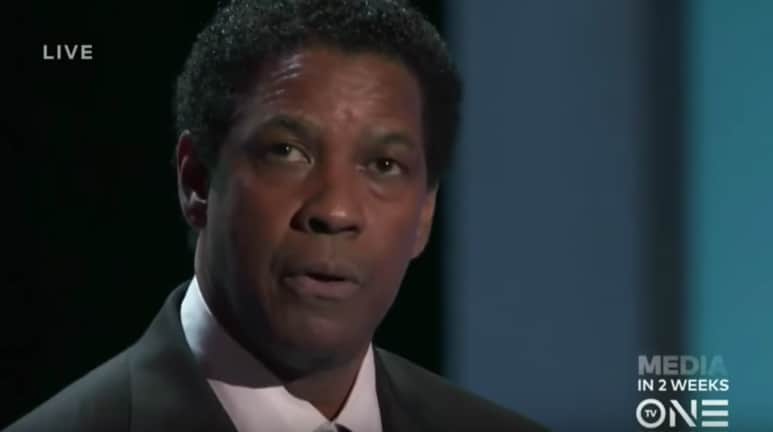
Click to play Denzel's 90 second speech..

I know you know exactly what I’m talking about. We have conversations sometimes, and in those, I hear the burning desire and determination that is required to succeed.

So, when I heard one of the great celebrity philosophers of stage and screen, Denzel Washington, this week give a short but profound acceptance speech for one of his many rewards, I was kind of blown away.

He was talking to you and me.

I heard it.

I started thinking about it.

And this is what I came up with:

HOPE is a an audacious, double-edged sword that cuts both ways unless you know how to wield it

Twenty-two years ago, when I was bouncing from couch to couch, friend to friend, family member to family member with the tiny bit of stuff I held onto packed in the back of my SUV, HOPE kept me alive.

When the love of my life came met me in the living room and told me she had cancer, HOPE helped me be strong and put one foot in front of the other.

When 6 months of unemployment with no job in site drained our bank accounts and kept me awake at night, HOPE was the only thing I wasn’t willing to give up.

When my online business began to feel like an abyss that was sucking me into oblivion, HOPE was the only thing that kept me from burning down everything we’d built.

But there’s a problem with HOPE…

As I sat with great HOPE – and that seemed to be the only thing I had, I kept asking myself if I was just being delusional.

Am I just being a pollyanna with my head buried so deep that I can’t see reality?

There are many people out there who tell you to snap out it, get real, and be practical. Essentially, they’ll crush your dreams if you let them. Always be on guard.

But also remember that those very same people may love you so much that they’re concerned you’ll be devastated when your dreams are dashed, and they think they’re protecting you from disaster.

Those people dashing your dreams are absolutely right, unless…

Listen up: HOPE can be what drives you forward, or it can keep you stuck in a constant state of despair.

Your next step determines which way this sword swings, because it’s in your hands.

You have to decide…

And that’s it. The first action I take when I’m in a desperate situation is to make a decision.

Will I step forward into the unknown, or retreat into the familiar.

The unknown is hard. COMMITMENT to change is required.

And change is hard, but as Denzel said in that acceptance speech, “Ease is a greater threat to progress than hardship.”

COMMITMENT is tricky. We think that COMMITMENT comes with great difficulty. But truly, you’re always COMMITTED.

Sometimes you’re COMMITTED to staying the same, and that means you’re COMMITTED to doing nothing new.

I know I’ve been there.

Who doesn’t want to sit down and rest? Do nothing? Let everything just happen?

But that’s not growth.

Quoting Denzel again, “Without COMMITMENT you’ll never start. Without consistency you’ll never finish.”

There it is. Make a decision. Be COMMITTED to it. And stick with it, as my dad says, “No matter what!”

So, what happens when you FAIL?

Because you will. We all do. FAILURE is the great blessing in our lives. It gets us one step closer to what works.

Nobody likes FAILURE, but FAILURE is an absolute essential element in growth.

It’s a paradox.

Without FAILURE, we have no idea if we can succeed.

Without FAILURE, there’s no opportunity to improve.

Without FAILURE, we can’t teach other people what works.

Eventually, we bump into enough walls, step in enough potholes, and exhaust all possibilities that the only thing left is success.

That’s only possible if we maintain HOPE and COMMITMENT.

The blessing of FAILURE is strength and growth. As the HOPE and COMMITMENT are tested, we get stronger, more HOPEFUL and more COMMITTED to finding the right solution.

Is this the path to every SUCCESS?

I’d like to say, “No, some people find success easily and fast.”

But that’s not my experience, nor is it the experience of anyone that I know who is successful.

Every example held up as an overnight success usually has traveled a path strewn with one discarded failure after another, but because they are so focused, committed and hopeful, we only hear about the sudden success.

That’s great, but the stories of overnight success can seriously cause many of us to cry out, “I’ll never make it.”

In fact, you’re on your path. You’re building your story. It takes what it takes to get you where you are.

Finally, I used to live in the problem bemoaning all my challenges and my failures. “Why me?” was my anthem.

Now, after many years of ups and downs, great decisions and bad choices, millions of dollars in and millions of dollars out, I wouldn’t trade any of those problems (i.e. FAILURES) for anything.

Everyone of them turned out to be a blessing and a stepping stone to the next great thing that happened in my life.

The Taoist story of the farmer who said “maybe”

I heard this story 20 years ago, when I was living in a 2-room apartment in Atlanta, loaded with more than a quarter-million dollars of debt, a $15 an hour job, and a whole lot of self-pity.

It made a ton of sense then and even more as I look back.

An old farmer had worked his crops for many years with his prized horse. One day, the horse ran away. His neighbors came to visit when they heard the news.

“Such bad luck,” they said sympathetically.

“Maybe,” the farmer replied.

The next morning the horse returned, bringing with it three other wild horses. “How wonderful,” the neighbors exclaimed. “You are so lucky!”

“Maybe,” replied the old farmer.

The following day, his son jumped on one of the wild horses to tame it and was thrown, breaking his leg.

The neighbors again came to offer their sympathy on his misfortune. “Maybe,” answered the farmer.

The next day, government officials came to the village to get young men in the army to fight a looming war.

The son’s leg was broken, so they did not grab him.

The neighbors who were lamenting the loss of their sons, once again, congratulated the farmer on his luck.

“Maybe,” said the farmer.

Never give up, NEVER give up…

Things never go as planned.

But if you have HOPE, COMMITMENT and learn from your FAILURES, SUCCESS is not far away…

Are You Looking For Support and Training So You Can Turn Your Failures Into Successes?

Try The MyNAMS Insiders Club For $1 Today!


Category: Featured Content, NAMS Notes, Productivity

  • Previous
  • 1
  • …
  • 12
  • 13
  • 14
  • 15
  • 16
  • …
  • 20
  • Next
  • Help Desk
  • Contact
  • Support
  • Privacy Policy
  • Earnings Disclaimer
  • Legal Notices
  • Membership Agreement
  • TOS
  • Testimonials
  • Affiliate Disclosure

Copyright © 2025 · MyNAMS.com · All rights reserved
NAMS, Inc. 203 CR 890, Etowah, TN 37331 USA

Disclosure: Some links on this website may be affiliate links. If you make a purchase through one of our affiliate links, we may earn a commission.
We only endorse products and services we use or trust.