Novice to Advanced Marketing System

NAMS | Building an Online Business to Support Your Dreams

  • Home
  • Product Catalog
  • Free Resources
  • Affiliates
  • Support
  • Blog
  • Masterminds
    • NAMS 90 Mastermind
    • Affiliate Sales Dominators Mastermind
    • Idea To Income Mastermind

Simple Steps to Get Content Published on Authority Sites

By Melanie Davis Team Account 1 Comment

Simple Steps To Get Content Published On Authority Sites

Get Content Published Research computer

What is your strategy to get your content published on the authority sites? 

Yes, there is a strategy behind it. And guess what? It is easier than you think - if you know the small details the pros know. 

Take the time to build out your strategy once, then reap the benefits over and over.

Research, Document, and Create Your Authority Publication System

  • Create a spreadsheet to document your research results.
  • Refine your core message and narrow down the focus to who you want to reach. 
  • Create your mission statement if you haven’t written one.
  • Gather your data for your Media Page or Media Kit.
  • Create your client Avatar.

Familiarize yourself with the authority sites you are interested in submitting your content to. Does it fit for you and your audience? Use your spreadsheet to note the type of content, themes, and categories. Make note of the ‘hot topics’.

You will want to keep a spreadsheet with notes for each publication site you research.

  • Review their Submission Guidelines and note specific conditions on your spreadsheet.
  • Determine who to send your submission by name.
  • Read and understand their terms and conditions for submission.
  • Note the publication’s preferred method of submission.
  • Can I use the Authority Site Logos on my sight?

NOTE: Be careful how you use their logo and name on your website. You do not want to imply that you are part of their staff or affiliated with the publication site. Usually, you will find that information in their Brand Guidelines. 

Use the words “As Seen In” above the authority site logo. Never have the authority site’s logo so big that anyone could confuse your site with the authority site. When in doubt, ask.

Editorial Calendar

Many Authority Sites will have an editorial calendar containing their upcoming themes and topics. This information is especially helpful so you can produce content around the topics. If you do not have an Editorial Calendar for your business, now is an excellent time to create one.

Allow for the time needed to do your research and write your article. Note your internal deadlines as well as publication deadlines. Plot your topics and titles on the calendar. Make adjustments, as needed. 

Once you have developed your editorial calendar, stick to it ~ every day.

Include topics and dates from your authority sites so you do not miss anything. It takes work, but the benefits are worth doing right.


Create a List of Your Existing Content to Repurpose

  • Books I have written
  • Reports I have created
  • Videos I can re-purpose
  • Podcasts
  • Other

Are you struggling to get started creating free content?  You may want to check out one of our most popular pieces of training called "How Free Products Lead To Profit".

Does Your Website Need a Facelift?

Is it time to update your website? Your website should be professional, down to having your photos taken by a professional photographer. Use clothing and accessories with the colors of your brand.

Above all, be yourself! Focus on your message, sharing and helping. When you care about your audience, they will feel that. 


Developing Content

Review your previous posts and articles to see if you can update any of them that had good engagement from your visitors. You can always block out time on your calendar to brainstorm topics. 

Use PLR/Done-for-You Content to get you started. It should be high quality and rewritten in your voice to your audience.

Read How to Create Efficient Content.

 

Do it now

Do This Now

  1. Begin following and interactive other top influencers. Comment on their posts a social media. Join their memberships and groups. Get them to respond to you. 
  2. Start publishing on LinkedIn. Get quality backlinks as a guest blogger on smaller sites. Do everything you can to grow your audience and become known as a top pro (without misrepresenting yourself).
  3. Push yourself past self-limiting beliefs. Every interaction, every publication to an authority site and every time you focus on helping your audience, you have the ability to grow your list. Get ready to push yourself daily toward earning your first authority site guest post. 


To get your content published on authority sites is not a one-shot deal. You have to begin with a plan and how to implement it. The research time alone can feel overwhelming. Split up the steps and do a little bit a day. Take the time to do it right. 

Stepping out of your comfort zone is courageous and scary at the same time. But remember, once you land that first authority site article or interview, it will be unbelievably easier to land the next one. So, get out there, use these proven steps and focus on being the best you can be.

 

get content published


Category: Content Creation, Featured Content, NAMS Notes

The Easiest Ways to Create Content

By Melanie Davis Team Account 1 Comment

Publishing and Repurposing Quality Content For Business Growth

Online business owners know that they need to consistently create content, whether for their website posts, articles, digital free reports and social media.  For many, just the thought of creating content feels overwhelming and scary.

You are not alone feeling this way. Killer content does take time and effort, however, there are ways you can save time by creating the quality content you want without spending hours a day to write it.

So, what is Quality Content?

Thinking about writing


It is more than being grammatically correct and having accurate information.

Let’s look at the elements that help you create quality content:

  • Interesting - Think about it: do you ‘’like” or follow boring content? Your content should be interesting or valuable to the reader. If not, they will not ‘share it’ on social media or continue reading what you put out. 
  • Entertaining  - Not all content needs to have the entertainment factor, however, this can be an element you work in with lengthy content.
  • Useful - Useful content comes into place like tutorials and educational material. Note: search engines love this format!
  • Well Researched - When you write a blog, you should include time to research the topic. Ideally, use multiple sources.
  • Factually Accurate - The last thing you need is inaccurate information to ruin your reputation and credibility. Always check to make certain you are distributing facts and truth.
  • Grammatically Correct - This sounds like a no-brainer, yet it remains a common problem of content providers. While you want it correct for the reader, it is equally important for the search engines. Google knows when your grammar, spelling, punctuation is correct, which makes an impact on your overall quality status.
  • Long - This continues to be debated. Google wants articles that provide value. Quality over quantity still rules!
  • Mixed Media - We know in this age of technology and all of the social media platforms available, you need more than a written blog. Video, digital books, along with images are definitely needed as part of your content distribution strategy.

These elements provide an excellent guideline on ways you should approach when you create content.

Easier Ways to Create Content

There is no getting around the need for written content. Let’s explore some ways that can make the process much easier.

Outsourcing -  This, of course, is your biggest way to save time and have quality content written specifically for you.

Roundups

Roundup for posts

This is a popular type of blog post. The readers get to discover an abundance of information on a single topic in one place. Creators love it because they do not have to write a lot of original content. If you are unfamiliar with Roundups, the basic process of creating one is simple.

  1. Pick a topic.
  2. Find several different pieces of content online that fit the topic. This can be articles, videos, audio or images.  
  3. Create an article that each links to each item, as well as a description for each. Your description link is the unique content that attracts search engine traffic and makes your article interesting to your readers.

Keep in mind that Roundups require a lot of work to create, but they do not require the same level of in-depth research that articles typically take since you are just writing a description of other people’s content. 

Interviews

What better way to connect with a niche-mate and their audience than to interview one. The only writing you need to do will be the questions for the interview. Email the person the questions and they send you the answers.

You can interview anyone who knows your topic. You want to select someone that is known in your industry. Bonus for you ~ their large following will be directed to your site to listen to their interview. This is a great way to get new traffic and followers.

Re-Blogging

This is a time-saver for you. Simply take someone else’s blog post or article and contact the writer for permission to publish it on your own site, giving full credit of the article to the writer.

Guest Posts

This technique is a win-win for you and the guest. You get free content and traffic to your site, and the guest receives new traffic to their site.

We have shared with you some of the easiest ways to have quality content created and published for your site.

What is your favorite way to create content? Please share it below.

Every month in the MyNAMS Insiders Club, we focus on a foundational business topic all businesses need to create sustainable long term income. February is our Content Publishing Challenge. If you need you to focus on publishing for your business, join us now for just $1. You'll get access to all of our workshops, challenges, courses, templates, workbooks, monthly PLR plus our weekly mastermind! It's the best deal for growing your online business.

Insiders Club Publishing Challenge-clicknow

Category: Featured Content, NAMS Notes

Are you talking to the right people?

By Jen Perdew 1 Comment

“Are You Talking to The Right People?”

Make sure your message is right for the market...

You wouldn’t advertise underwear at a nudist camp, right?

A great salesperson can sell anything to anyone, right?

Let’s get the cliches out of the way right away… here’s a few examples:

  • He could sell sawdust to a lumberyard.
  • She could sell hay to a farmer.
  • He could sell wood to a forest.
  • She could sell a cape to Superman.
  • He could sell crutches to a sprinter.
  • She could sell a cage to a lion.
  • He could sell ice to a polar bear.
  • She could sell salt to a thirsty man.

This is relative to the topic today, because I’m going to prove to you that a GREAT salesperson NEVER sells someone something they don’t need.

In fact, if your message doesn’t match the actual market need with a real solution, expect at best one-time sales to customers who will never buy anything else from you again and at worst more refunds than you can handle.

Either way, your reputation is destroyed.

A great salesperson is a problem solver and a service provider.

A great business finds the problems in a market and creates solutions THAT group needs - desperately.

Once the problem is clarified and the solution is identified, the exact market with the desperate issue has to see the solution as not only an opportunity to fix a problem but a real Godsend.

When that happens, prospects come looking for you. And your business blows up.

So, What’s the problem?

Communication. It’s always communication.

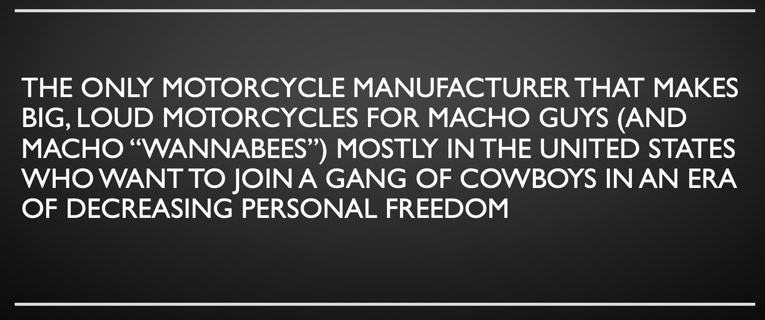
Let’s look at an example. Read this brand message paragraph below. If you know anything about motorcycles, you have no doubt who this company is without naming the product.

MotorcycleStoryBrandImage

But what’s the problem? Is it that we’re in an...

“Era of decreasing personal freedom”

Or that these are…

“Macho guys (and Macho ‘Wannabees’)” 

Or that these guys want to…

“Join a gang of cowboys”

Look at it again.

In an era of decreasing personal freedom, these Macho guys (and Macho ‘Wannabees’) want to join a gang of cowboys…

That’s not really a problem. It’s a description of the symptoms of a problem. 

In fact, the problem is more emotional than physical. By the way, it’s ALWAYS more emotional because a desperate problem causes some kind of pain, loss, or deprivation.

When describing the problem, it’s important to ask people suffering the problems a few  questions:

  • What does it feel like to experience that problem?
  • When does the problem first appear?
  • Does the problem cause you emotional pain or suffering? In what way?
  • Do the people in your group have this problem? Does the group want a solution?
  • How does the problem affect your livelihood, status, money or relationships?
  • Does the problem seem desperate and/or hopeless?
  • Would you pay for a solution to the problem?

Identifying the problem is difficult. We talk around it to get the feeling behind it.

Having been a Harley Davidson rider myself, the problem in our example is:

Men want something that makes them feel like men again.

There’s insecurity, longing for respect, more prestige and some serious mid-life crisis resolution going on. 

Motorcycle-06

But no company is ever going to advertise that they’re “The ONLY motorcycle manufacturer that makes big, loud motorcycles for men going through a midlife crisis.”

But that’s a heck of a market. Motivated men with discretionary money and enough insecurity to want a lot of power under their butts.

Of course, that is not stated explicitly in the brand copy but the message resonates with the buyers in the market! 

Actually, it’s not even a hard sell. 

If you get the message in front of the right market, the only thing left to do is pick out the color, check the motorcycle inventory and schedule a delivery date.

This works in any niche if you find a motivated buyer with a desperate problem that you can solve.

But the key is putting the right message in front of them. 

Get that right, and a bad salesperson becomes a wealthy person.

Dan Kennedy, one of the most respected marketers in the world, said something like this (and I’m paraphrasing), 

If you have the right message-to-market match, then your sales message doesn’t have to be that good to ‘work’. BUT if you have the WRONG message-to-market match, then the best sales letter in the world won’t work at all.

We’ve had a lot of success selling products to interested audiences.

And we’ve had our share of flops too.

When we send an email that gets little response, the issue is usually that the message didn’t resonate with that audience.

It didn’t match. In some way, it was incongruent.

Nothing kills marketing faster than incongruence.

A marketing relationship is like a date. 

Having a rich, sumptuous dinner at a 5-star French bistro complete with a soulful jazz singer accompanied by a soft piano and a stand-up bass sets the tone for an elegant, relaxed, intimate evening.

Follow dessert with ring-side seats at a mixed martial arts slugfest with sweat, blood and god-knows-what-nastiness raining down on you seems a bit (maybe a ton) incongruent with your original message. 

And probably spells the end of that relationship.

Incongruence is a jolt to the system.

It’s like walking on the beach in a snowstorm. 

Or dogs smoking cigars and playing poker around a table piled with chips and cash.

The subtlest of inconsistencies can coat your message with a thick layer of what-the-heck-is-this? And if they have to ask that question, it will confuse your market to the point that they walk away. 

A confused prospect will not buy anything.

So your brand message has to be congruent from the first word to the last. If there’s a hiccup along the way, you’ll lose the market.

To reinforce your brand message, tell stories

Stories help your audience remember your message clearly because they attach the emotion and images you create with a narrative.

A message without a story is just data.

Nothing cements a message in a prospect's brain like a story. And if you create a story around your message and deliver it to the right market, they will remember the story for years to come hanging on to your message all the while.

So, your assignment is to create a brand message that is clear and succinct. Then, wrap that message with an entertaining story that’s hard to forget.

I know what you’re thinking…

“I don’t know any stories.”

Of course, you do. You tell dozens of them every day. All you need is a little instruction on how to shape those stories into unforgettable tales that embed your brand message to leave a memorable impression on your market.

That’s why we’ve created our brand new Simple Story Selling course.

In part 1 of this 4-part course, we focus on using stories to communicate the brand message most effectively to drive sales and keep the pipeline full.

We break down these messages into a simple 6-part formula using the book Zag: The #1 Strategy of High Performing Brands.

And then, we find the right market that wants to hear your story.

But first, it starts with the brand message. And you can download a special fill-in-the-blanks template today to create your compelling brand message fast.

Download the template and pop your new brand message in the comments below.

Category: Featured Content, NAMS Notes

5 Affiliate Marketing Strategies that Convert Like Crazy

By David Perdew 3 Comments

5 Affiliate Marketing Strategies that Convert Like Crazy

These are my favorite techniques that have earned us more than a million dollars in affiliate commissions over the years. 

And believe me, we’ve tried dozens of techniques.

First, if you’re looking for secret shortcuts here, you’ll probably be disappointed. We like to focus on the fundamentals to build a solid business and I really encourage you to do the same.

Probably, the most important things we do that makes us successful affiliate marketers are:

  • Cull - focus on the good stuff. Only promote products that are going to enhance our members productivity and enhance our reputations.
  • Commit - once we make a decision to promote, we use the product, get to know it inside out and go all in on the promotion 
  • Continue - stick with it. If it’s a 5-day promotion, we continue to promote through the entire period. If it’s evergreen, we schedule it over time and create content to support it.

We’re in it for the long haul. That’s rewarded us well. And we’ve created great partnerships and relationships.

So, in the 10 years we’ve been doing this, these 5 tactics have become our favorite:

#1 Favorite Method - Email Marketing

Email marketing is still the king of online marketing ROI.

If you’ve got a list of prospects, mailing them offers can earn you a lot of money, if you do it correctly.

If you have no list now, obviously you can’t be effective with email marketing, so building your list is the priority.

There are two schools of thought.

  1. Short, sweet, direct and salesy. Many affiliate marketers prefer this. And some make a ton of money with 2 paragraph emails without any relationship building. We don’t do this.
  2. Value-based, story-based relationship. This is where we excel. Our emails are longer. Our goal is to build a long-term relationship with our community.

We almost always start with a personal story that highlights the problem and reveals the solution. 

I reveal things about my personal life (and sometimes that of my family too) so that people feel like they know me well because friends buy from friends.

By the time, the story and the solution are revealed, someone clicking to the sales page is prepped positively to make the purchase WITHOUT spending a lot of time on the sales page.

This is important.

Sometimes, sales pages for really good products can hurt the sales, so we’ll even tell people sometimes that the product is great, but the sales page is really bad. Scroll to the buy button and click it.

#2 Favorite Method - Bridge Pages

A bridge page bridges the buyer from your promotion to the sales offer.

It’s important because it’s a chance to do a warm review or Demo of the product. This is usually done with video. You don’t have to be on the camera, but you can still do a product walk through or Demo of how the product solves the problem.

It is really important to use your voice for the most effective warm handoff.

A bridge page is all about delivering targeted traffic. Period.

The affiliate link is on the button in the Bridge Page. So, the ONLY people who click that button are the ones who are interested in the product.

Others have decided based on your Bridge Page that they are not interested and go away. Product owners REALLY appreciate that because your conversion rates will be huge even if your clicks are small.

Here’s what one partner said about our promotion using a bridge page.We were getting $37 EPC. That means for every click to the sales page, we made $37. Most were making less than a quarter of that.


Pick Up The Full 5 Affiliate Strategies That Convert Ebook Now!
 

#3 Favorite Method - Demonstrations / Walkthroughs

When I was a kid, I watched a door-to-door salesman who knocked on our door to demonstrate a Rainbow vacuum.

It was like a magic show. 

The Rainbow was a water-based vacuum with a clear case.

This thing was built for in-home demonstrations. And it was all the rage for awhile.

The salesman would throw some dirt on the floor - good ol’ rich, black d

irt, and the vacuum would suck it up turning the spinning water in the clear case into dark mud.

How could you refuse? It worked - like magic.

Nearly everyone rails against multi-level marketing companies (and Rainbow was one), but Direct Sales or Network Marketing or MLM - whatever you want to call it - was built on the in-home Demo model, or “Party Plan”.

Think about.

  • Tupperware
  • Amway
  • Avon
  • Pampered Chef
  • Scentsy
  • Mary Kay
  • Send Out Cards
  • Isagenix

Just to name a few.

I’m not suggesting you join an MLM. The in-home Demo sales is dying if not already deceased. But the concept can be translated to the online world because people want to see how stuff works before they buy it.

A Demo can be video or text with images, but the goal here is very simple: Show prospects how it works and what they’re getting.

That’s why Demonstrations must include two qualities:

  1. Detailed “How to Use” (insert product) information, plus…
  2. Proof. Remember the dirt on the floor becoming mud in the water, that’s Proof with a capital P.

Your Demo needs to be just as convincing.

Combining the Demo with the Bridge Page and you have an incredibly effective process that converts like crazy.

#4 Favorite Method - Case Studies

I love Case Studies. I love to read them and love to produce them. And love to use them to make even more affiliate product sales.

We’ll talk about two kinds of Case Studies here but I cover video case studies as well in my ebook (you can grab that at the bottom of the page):

    1. Case Studies as reports
    2. Case Studies as blog posts

Case Studies all have a few things in common:

    • Detailed training sessions 
    • Teach people how to do something
    • Authority based on real experience
    • Includes the tools and resources
    • Reveals the results

Without results, the training is really just theory and doesn’t have the authority of experience. 

Case Studies can’t be produced overnight though because the experience often takes awhile to build.

But Case Studies in any format are awesome because everyone naturally wants to know which tools and technology you used to get the results. In fact, they’re disappointed if you don’t have the resources listed at the end of the report or video.

Case Study as Report

I’m an old newspaper editor, so I love putting together special reports. Case studies are a natural.

In a good Case Study report, we include:

  • Problem identification
  • Solution identification
  • Step-by-step instructions for implementing the solution
  • Images like graphs, tables, charts, drawings, or screenshots that clarify the process visually
  • The tool that made the solution possible with an option to purchase it.

Case Study Reports don’t have to be 7-figure successes. It doesn’t have to be that flashy. Any success can be turned into a Case Study.

In fact, here are a few examples of Case Study opportunities:

  • My first sale
  • My first $1,000
  • My first $10,000 month
  • How I won a contest
  • How I tripled my list in 60 days
  • How I created my first successful ad campaign
  • How social media delivered 10 new clients this week
  • The effectiveness of my 10 day Influencer campaign
  • One customer’s journey using my product

And about a million more.

Sometimes, a Case Study report can be a product as well.  We did exactly that with our 5 Days to $12K Case Study. 

During a 5-day, middle tier, launch promotion, we took first place on the leaderboard while competing with some of the top names who have much larger lists.

The product owners were interested in how we did it. So, I created a detailed 37-page Case Study outlining the daily process and the techniques we used to claim the first prize and more than $12,000 total.

And this Case Study continues to sell even 2 years later.

Case Study as blog post

Since we’re covering blog posts in the next method, we won’t spend much time on it here.

A blog post Case Study is limited by space. Once a blog post gets to 3,000 words or more, it becomes cumbersome - and tiresome. Anything longer should probably become a report.

But Case Studies less than that word count can be very effective and make great anchor posts. 

Search Engine Optimization people love blog posts Case Studies because they’re shareable. Shareable content becomes back links which give the blog even more authority in the search engine results.

Essentially though, a Case Study as a blog post has the same goal and structure as the other two types we’re highlighting.

With any of the three types of Case Studies, the goal is the same: Use overwhelming proof through the step-by-step training to persuade the reader or viewer to purchase the tools to achieve the same solution.

Pick Up The Full 5 Affiliate Strategies That Convert Ebook Now!
 

#5 Favorite Method - Blog Posts

It’s almost impossible to have an online business today without some kind of blog.
You can do video blogging, story blogging, product review blogging and even educational articles on your blog.

All of those can be very useful as an affiliate marketer.

Let’s talk about product reviews.

This is a fantastic way to create long term, drip income - the surprise sale that shows up unannounced year round. One of my old mentors used to call that mailbox money.

A product review is different from a Case Study in a couple of ways.

Think of the popular “unboxing” videos you see on YouTube or in some marketers’ feeds. They like to open the box, pull out the product, turn it over, open it up, turn it on (if need be) or install it, and see that it works.

Results are not really the issue. Remember, a Case Study is about the step-by-step processes used to achieve specific results.

The product review is strictly features and benefits.

Product X has Feature 1 and Feature 2 which yield Benefit 1 and Benefit 2.

My Glasses (PX) have a clear frame (F1) and UV protection on the lenses (F2) which helps me be a little more stylish than my old glasses (B1) and protects my eyes from the sun (B2).

There’s no proof that I AM more stylish or that my eyes are better protected. Those wouldn’t be verifiable results unless I had specific stats to support it. 

The key is to be really honest. If there’s something you don’t like, point it out. If it is better than a competitor, do a side by side comparison.

The more detail, the more your reader will agree with you and buy. 

Your review counts. Reviews are so important that Amazon incorporated them into EVERY product they sell. 

The psychological value of a review is immense. It’s called social proof. Social proof is the thing that convinces everyone it’s okay to take chance because other people have taken that chance already - successfully.

Here’s an example:

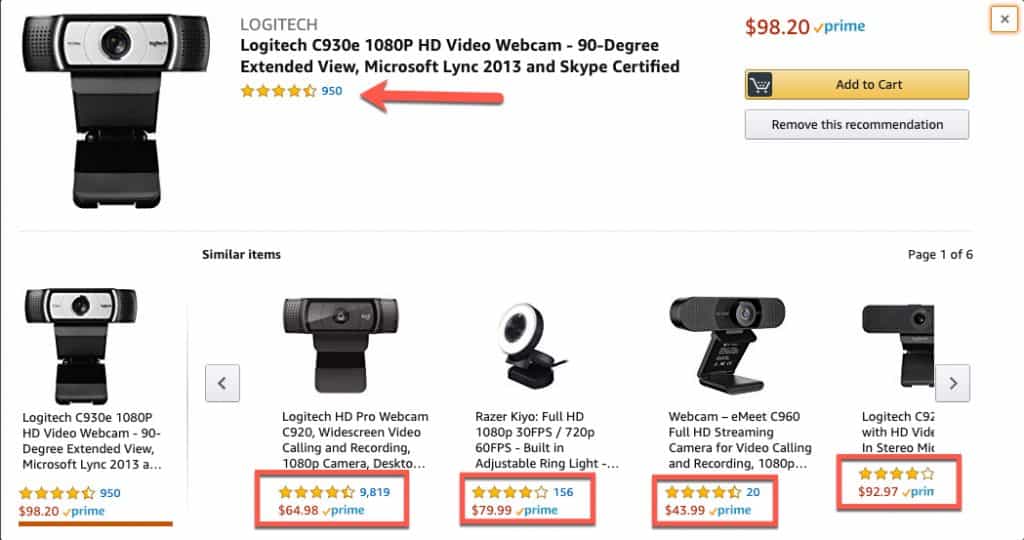
When shopping for a new webcam, price and buyer reviews are probably the two most important factors shoppers pay attention to.

If we wrote a blog post recommending the Logitech C930e vs the others suggested by Amazon on this page, we’d tailor it to highlight the benefits of the c930e by describing the features and benefits.

But it’s the most expensive - nearly $100.

But it has great reviews - 950 4.5 star average.

The only real competitor on the page is the Logitech c920. It has the same review average with 9,819 reviews and is just $65.

As a shopper, I’ve quickly eliminated all but two options by looking at price and reviews. It’s time to compare the two - use my affiliate link to both. We’re setting the high bar with the c930e and touting why it’s so great. And we acknowledge the c920 is awesome too because it has so many reviews, but it is the older model.

So, I’d pull out the features - side by side - and compare them.

The good thing is that no matter webcam the buyer purchases, my link is attached to the buy button.

Cha-Ching.

Put It All Together

You may have noticed that all 5 of our favorite methods for selling affiliate products seem to have a connection. Essentially, by using these 5 methods, you’re creating a really sweet content plan that is monetized. 

Combining Email Marketing to Bridge Pages with Demos and Walkthroughs or Case Studies and finishing off with a Blog Post gives you a ton of evergreen promotional methods and opportunities.

I hope you see this as a way to improve your affiliate marketing!

If you want to learn more about how to use these strategies along with examples, click the button below and download my Ebook 5 Affiliate Marketing Strategies That Convert. It's over 21 pages of fully detailed strategies, examples, videos, and links to check out our best performing content.

Pick Up The Full 5 Affiliate Strategies That Convert Ebook Now!
 

Category: Affiliate Marketing, Featured Content, NAMS Notes

Efficient Content Writing and iWriter Review and Case Study

By David Perdew 1 Comment

How to Create Efficient Content, Writing with iWriter, Review and Case Study, to Create Better Cheaper Content Fast!


Click the link below to get Custom Content Wizard with our Special Pricing...

And to use iWriter, click this link below...

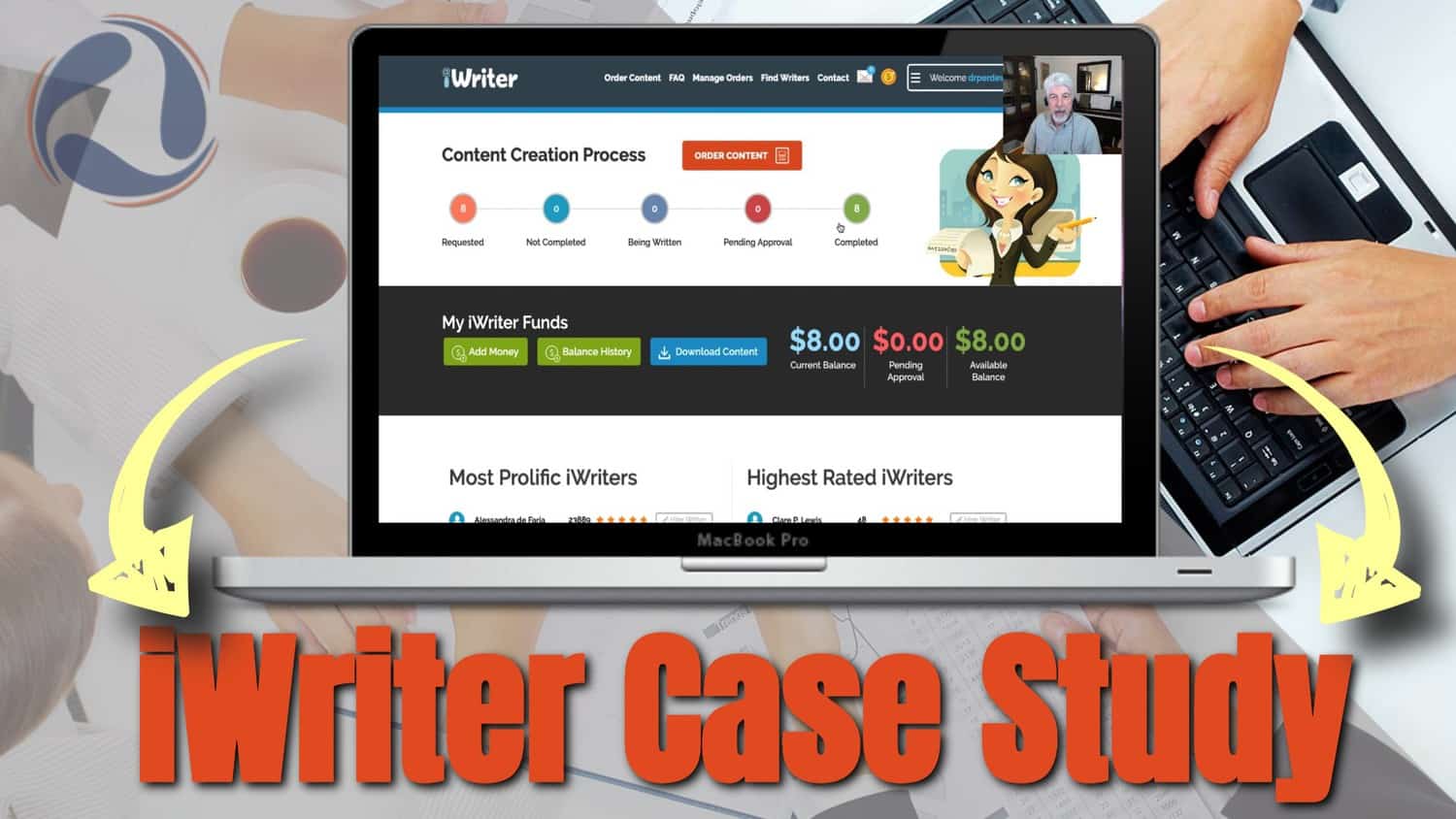
** Efficient Content Writing and iWriter Review Case Study **

Resources: https://NAMS.ws/iwriter and Custom Content Wizard here: https://NAMS.ws/CCW

Writing articles can be a really time consuming process. That's why it's really important to be as efficient in creating 100 percent original content when blog writing.

Whether you're trying to figure out how to write a blog or write articles for money, we've got a few hints for you in this iWriter case study.

By using iWriter in conjunction with a fantastic article and content idea generator like Custom Content Wizard (at https://NAMS.ws/CCW), we can be really efficient when creating our marketing articles.

It's really a simple process after getting Custom Content Wizard.

Step 1: Answer the step-by-step questions to define the topic benefits, myths, mistakes, tips and tools.

Step 2: Build and save all the articles with CCW to your computer.

Step 3: Choose one and copy and paste the outsourcing instructions to iWriter.

Step 4: Wait a few hours to get your draft article.

Step 5: Review and accept the article.

In the video, we show the process and look at whether it's worth it to get the high-dollar version (Elite Plus) vs. the much more reasonable (Elite) version.

Leave a comment if this has been helpful.

And go to https://NAMS.ws/iWriter to get started with iWriter. Custom Content Wizard is here: https://NAMS.ws/CCW

Category: Content Creation, Featured Content, NAMS Notes

  • Previous
  • 1
  • …
  • 9
  • 10
  • 11
  • 12
  • 13
  • …
  • 20
  • Next
  • Help Desk
  • Contact
  • Support
  • Privacy Policy
  • Earnings Disclaimer
  • Legal Notices
  • Membership Agreement
  • TOS
  • Testimonials
  • Affiliate Disclosure

Copyright © 2025 · MyNAMS.com · All rights reserved
NAMS, Inc. 203 CR 890, Etowah, TN 37331 USA

Disclosure: Some links on this website may be affiliate links. If you make a purchase through one of our affiliate links, we may earn a commission.
We only endorse products and services we use or trust.